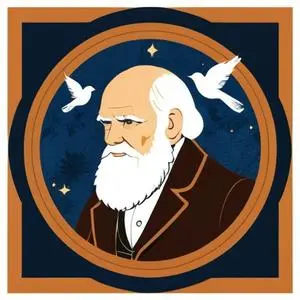
Charles Darwin: The Father of Evolution
The Theory of Evolution
Charles Darwin is widely recognized as one of the most influential scientists in history, and his groundbreaking theory of evolution by natural selection has revolutionized the way we understand the natural world. In a nutshell, Darwin proposed that all species of life have descended from a common ancestor, and that this branching pattern of evolution resulted from a process of natural selection, where the struggle for existence has a similar effect to the artificial selection involved in selective breeding.
Early Life and Education
Born on February 12, 1809, in Shrewsbury, England, Charles Darwin was the fifth of six children to Robert and Susannah Darwin. His love for nature and the outdoors was evident from an early age, and he spent much of his childhood collecting specimens and observing the natural world. Darwin's interest in science was encouraged by his parents, and he was sent to the University of Edinburgh to study medicine. However, he soon became disenchanted with the idea of pursuing a career in medicine and instead turned his attention to natural history.
The Voyage of the Beagle
In 1831, Darwin embarked on a five-year voyage aboard the HMS Beagle, which was commissioned by the British government to conduct a survey of the coast of South America. During this journey, Darwin collected numerous specimens and made observations that later formed the basis of his theory of evolution. The voyage was a transformative experience for Darwin, and it was during this time that he began to question the traditional view of creationism.
The Development of the Theory of Evolution
Upon his return to England, Darwin began to analyze the specimens he had collected during his voyage and started to develop his theory of evolution. He was particularly puzzled by the geographical distribution of wildlife and fossils, and he realized that the species he had observed were not fixed entities, but rather had evolved over time through a process of natural selection.
Publishing the Theory
Darwin's theory of evolution was first published in 1859 in his book "On the Origin of Species," which was a comprehensive and meticulously researched work that presented his ideas to the scientific community. The book was a huge success, and it sparked a lively debate about the nature of evolution and the role of natural selection.
Legacy and Impact
Darwin's theory of evolution has had a profound impact on modern science and has influenced many fields, including biology, ecology, and medicine. His work has also had significant implications for philosophy, religion, and our understanding of human nature. Today, Darwin is widely regarded as one of the most important scientists of the 19th century, and his theory of evolution is recognized as a fundamental concept in modern biology.
Personal Life and Relationships
Darwin was a devoted husband and father, and he married Emma Wedgwood in 1839. The couple had 10 children together, and Darwin was known for his love and devotion to his family. He was also a close friend and correspondent of many prominent scientists of his time, including
Alfred Russel Wallace, who independently developed a similar theory of evolution.
Controversies and Criticisms
Darwin's theory of evolution was not without its critics, and he faced opposition from many quarters, including the scientific community, the church, and the general public. However, Darwin remained committed to his ideas and continued to refine and develop his theory throughout his life.
Quotes and Memorable Sayings
- "It is not the strongest of the species that survives, nor the most intelligent that survives. It is the one that is the most adaptable to change."
- "In the long history of humankind, those who learned to collaborate and improvise most effectively have been the ones who have prevailed."
Awards and Honors
Darwin was elected a Fellow of the Royal Society in 1839 and was awarded the Royal Medal in 1853. He was also awarded an honorary doctorate from the University of Cambridge in 1877.
Visual Timeline
| Year |
Event |
| 1809 |
Charles Darwin born |
| 1831 |
Voyage of the Beagle begins |
| 1836 |
Voyage of the Beagle ends |
| 1859 |
"On the Origin of Species" published |
| 1882 |
Charles Darwin dies |
Trivia and Fun Facts
- Darwin was a talented musician and played the flute in his spare time.
- He was a passionate advocate for the abolition of slavery and was involved in several campaigns to end the slave trade.
- Darwin's love of nature and the outdoors was inspired by his grandfather, Erasmus Darwin, who was a prominent naturalist and poet.
Inspirational Story and Motivation
Darwin's story is an inspiration to anyone who has ever doubted their own abilities or faced criticism and opposition. Through his perseverance, dedication, and commitment to his ideas, Darwin changed the course of scientific history and left a lasting legacy that continues to inspire and influence people around the world.
FAQ
What is Charles Darwins most famous scientific theory?
Charles Darwins most famous scientific theory is evolution through natural selection, which he outlined in his book On the Origin of Species. This fundamental concept revolutionized our understanding of biology and the natural world.
What inspired Charles Darwins theory of evolution?
Charles Darwins theory of evolution was inspired by his observations of finches and other species during his voyage on the HMS Beagle. He noticed variations in species across different islands and continents, leading him to propose the concept of adaptation and natural selection.
What was Charles Darwins contribution to the field of geology?
Charles Darwin made significant contributions to the field of geology, including his observations on volcanic islands, coral reefs, and the geology of South America. His work helped to establish geology as a scientific discipline.
How did Charles Darwins work influence the development of modern biology?
Charles Darwins work on evolution and natural selection laid the foundation for modern biology. His ideas have had a profound impact on fields such as genetics, ecology, and conservation biology.
What is Charles Darwins legacy in the history of science?
Charles Darwins legacy in the history of science is that of a pioneering thinker who challenged traditional views of the natural world. His theory of evolution remains a cornerstone of modern biology, and his work continues to inspire new generations of scientists and thinkers.