


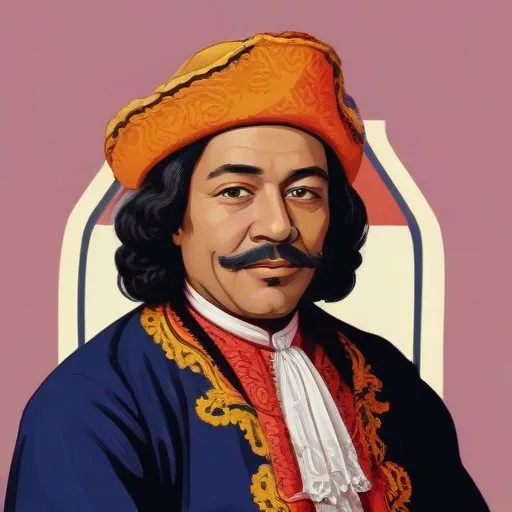
Founder of Cape Town and first Governor-General of the Dutch East Indies, known for establishing a refreshingly tolerant and multicultural society in 17th-century South Africa.
Abraham van Riebeeck was a renowned Dutch merchant and Governor-General of the Dutch East Indies from 1709 to 1713, known for his exploration expeditions, agricultural innovations, and significant contributions to the Dutch East India Company. Born in the Dutch Cape Colony, present-day South Africa, Van Riebeeck's legacy extends far beyond his administrative roles, leaving a lasting impact on the history of the Dutch East Indies.
Van Riebeeck was born on October 18, 1653, to Jan van Riebeeck, commander of the Cape, and Maria van Riebeeck. In 1662, his father moved to Batavia, present-day Indonesia, and sent Abraham and his brother to Holland for education. Van Riebeeck studied law at Leiden University from 1673 to 1676, laying the foundation for his future career in administration and trade.
After completing his studies, Van Riebeeck joined the Dutch East India Company as a merchant and traveled to Batavia on the ship De Vrijheyt in 1677. He married Elisabeth van Oosten in 1678 and had six children with her. His administrative skills and business acumen quickly earned him recognition, and he rose through the ranks to become Governor-General of the Dutch East Indies in 1709.
As Governor-General, Van Riebeeck undertook several exploration expeditions, expanding the Dutch East India Company's presence in the region. One of his most notable achievements was landing in Palabuhanratu and successfully growing coffee plants in 1712. This pioneering effort marked the beginning of Indonesia's coffee industry, which would become a significant contributor to the country's economy.
Van Riebeeck's personal life was marked by tragedy, with three of his children dying in their childhood. Despite this, he remained committed to his duties and continued to explore the region. In 1712, he became the first person to reach the summit of Tangkuban Perahu, a remarkable feat that cemented his reputation as a fearless explorer.
Tragically, Van Riebeeck's life was cut short when he contracted dysentery on his way home from Tangkuban Perahu. He died on November 17, 1713, in Batavia, leaving behind a legacy that would shape the history of the Dutch East Indies.
Abraham Van Riebeeck's contributions to the Dutch East India Company and the development of Indonesia's coffee industry have had a lasting impact on modern society. His exploration expeditions and innovations paved the way for future generations of traders, administrators, and explorers, solidifying his place as one of the most influential figures in Dutch colonial history.
Abraham Van Riebeeck's remarkable life and achievements have left an indelible mark on Dutch colonial history and the development of Indonesia. His pioneering spirit, administrative skills, and innovative ideas continue to inspire generations, cementing his place as one of the most influential figures of the 18th century.
Born in 1619
Founder of the first permanent Dutch settlement in South Africa, establishing a refreshment station at the Cape of Good Hope that eventually grew into the city of Cape Town. He played a crucial role in the Dutch colonization of South Africa.
Born in 1639
The founder of Stellenbosch and the first governor of the Dutch Cape Colony, who established a successful settlement and explored the region, expanding Dutch influence in South Africa.
Born in 1587
Founded the Dutch East India Company's headquarters in Batavia, Java, and played a crucial role in establishing the Dutch colonial empire in Indonesia. He's infamous for his brutal suppression of native populations and rival trading companies.
