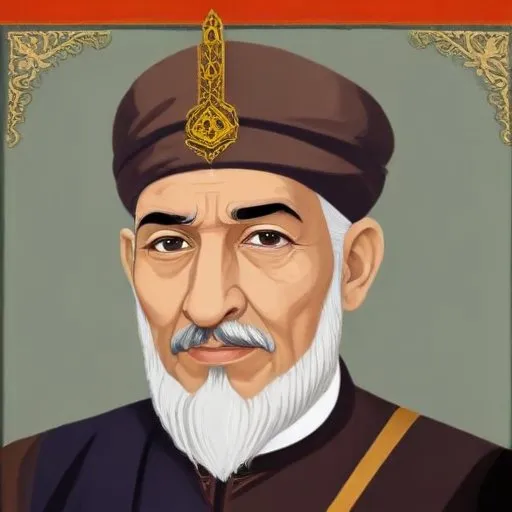
Abu Said Bahadur Khan: The Ninth Ruler of the Ilkhanate
A Legacy of Turmoil and Transformation
Abu Said Bahadur Khan, the ninth ruler of the Ilkhanate, a division of the Mongol Empire, is best known for his tumultuous reign that ultimately led to the disintegration of the Ilkhanate after his death in 1335. As the ruler of a vast empire that encompassed present-day countries of Iran, Azerbaijan, Georgia, Armenia, parts of Iraq, Turkey, Afghanistan, and Pakistan, Abu Said's legacy is marked by a complex web of power struggles, alliances, and rebellions.
Early Life and Ascent to Power
Born on June 2, 1305, near Ujan, Tabriz, Abu Said was the son of Iljaitu and Hajji Khatun. Following the deaths of his elder brothers, he became his father's heir and was appointed to govern Khorasan and Mazandaran in 1315, with the Uyghur noble Amir Sevinch as his guardian.
Reign and Power Struggles
Abu Said's coronation was delayed until April, May, July or August 1317 due to a conflict between Chupan and Sevinch. During his reign, he employed Rashid al-Din Hamadani and Taj al-Din Ali Shah Gilani as his viziers. However, the viziers were at odds, leading to Hamadani's dismissal in October 1317. Amir Sevinch's death in January 1318 left young Abu Said in the hands of Chupan, who became the de facto ruler of the Ilkhanate.
The Golden Horde Invasion and Rebellion of Amirs
In 1319, the Golden Horde Khan, Zbeg, invaded Azerbaijan in coordination with Chagatayid prince Yasaur, who had pledged loyalty to Iljaitu earlier but revolted in 1319. This invasion led to a series of rebellions and power struggles that marked Abu Said's reign. Yasaur's rebellion was crushed, but Abu Said's troubles continued as Amir Yasaul, governor of Mazandaran, was killed by his subordinate Begtt.
Legacy and Impact
Abu Said's reign was marked by turmoil and transformation. Despite the challenges he faced, he managed to maintain control over the Ilkhanate, albeit with the help of powerful nobles like Chupan. His death in 1335 led to the eventual disintegration of the Ilkhanate, which was eventually divided into several smaller khanates. Today, Abu Said Bahadur Khan is remembered as a pivotal figure in the history of the Mongol Empire, whose reign marked the beginning of the end of the Ilkhanate.
Historical Context and Legacy
Abu Said's reign took place during a time of great upheaval in the Mongol Empire. The death of the Mongol emperor, Temur Oljeitu, in 1307 led to a series of succession crises and power struggles that weakened the empire. Abu Said's reign was marked by a similar pattern of power struggles and rebellions, which ultimately contributed to the decline of the Ilkhanate.
Personal Milestones and Key Life Events
- Born on June 2, 1305, near Ujan, Tabriz
- Appointed to govern Khorasan and Mazandaran in 1315
- Coronated as the ninth ruler of the Ilkhanate in 1317
- Death in 1335, leading to the disintegration of the Ilkhanate
Trivia and Fun Facts
- Abu Said's name is spelled differently in various sources, including Abusaid Bahador Khan, Abu Said Behauder, and Abu sayid Baghatur Khan.
- He was known for his diplomatic skills and was able to maintain relations with the Golden Horde and other neighboring khanates.
FAQ
Who was Abu Said Bahadur Khan?
Abu Said Bahadur Khan was the ruler of the Ilkhanate, a khanate that existed from the 13th to the 14th century. He ruled from 1316 to 1335 and was known for his military campaigns and administrative reforms.
What were Abu Said Bahadur Khans military campaigns?
Abu Said Bahadur Khan led several military campaigns during his reign, including campaigns against the Golden Horde, the Mamluk Sultanate, and the Chagatai Khanate. He was able to expand the Ilkhanates borders and secure its territories.
How did Abu Said Bahadur Khan reform the Ilkhanates administration?
Abu Said Bahadur Khan implemented several administrative reforms during his reign, including the creation of a centralized bureaucracy, the establishment of a uniform system of taxation, and the promotion of trade and commerce.
What was Abu Said Bahadur Khans relationship like with his nobles?
Abu Said Bahadur Khan had a complex relationship with his nobles, who often vied for power and influence. He was able to maintain stability and balance among the nobility through a combination of diplomacy and military power.
How did Abu Said Bahadur Khan die?
Abu Said Bahadur Khan died in 1335, likely due to a plague or illness. He was succeeded by his cousin, Arpa Keun, who would go on to rule the Ilkhanate for several years.