


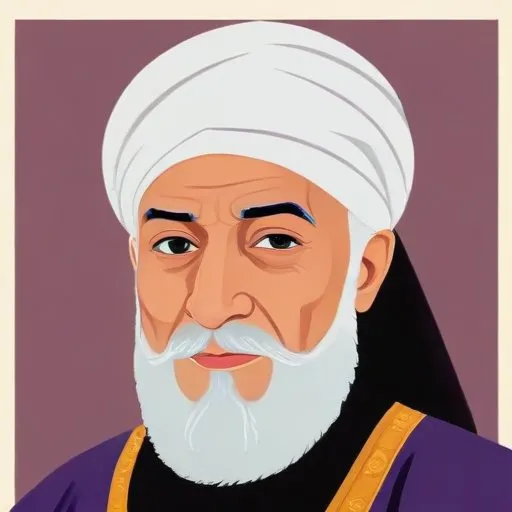
Grand vizier and historian who served under Emperor Akbar, chronicling the Mughal Empire's history and achievements in his monumental work, the Akbarnama. He was a master of Persian literature and a skilled administrator.
AbulFazl ibn Mubarak, a renowned Persian historian, scholar, and courtier, is best known for his monumental work, the Akbarnama, a comprehensive chronicle of the reign of Mughal Emperor Akbar. As a trusted advisor and confidant of Akbar, AbulFazl played a pivotal role in shaping the Emperor's policies and providing valuable insights into the workings of the Mughal administration.
Born in 1551 in Agra, India, AbulFazl was the son of Shaikh Mubarak Nagori, a prominent Sufi saint and scholar. From a young age, AbulFazl demonstrated a keen intellect and a thirst for knowledge, which led him to pursue higher education in various centers of learning, including Delhi and Lahore. He studied a range of subjects, including theology, philosophy, literature, and mathematics, under the guidance of esteemed scholars and teachers.
In 1575, AbulFazl joined the Mughal court as a young scholar and quickly gained the attention of Emperor Akbar, who was impressed by his exceptional intellectual abilities and his mastery of Persian and Arabic languages. AbulFazl's entry into the Mughal court marked the beginning of a long and productive association with the Emperor, during which he played a crucial role in shaping the policies and reforms of the Mughal Empire.
The Akbarnama, AbulFazl's most celebrated work, is a comprehensive history of the Mughal Empire during Akbar's reign. This monumental work, which took over a decade to complete, provides a detailed account of the Mughal administration, its policies, reforms, and military campaigns. The Akbarnama is divided into three volumes, with the first volume covering the reign of Akbar from 1556 to 1592, and the second and third volumes focusing on the reigns of his predecessors and successors, respectively.
AbulFazl was a strong advocate of the concept of sulh-i-kul, or "universal peace," which emphasized the importance of social harmony, religious tolerance, and cultural pluralism. He believed that the Mughal Empire's strength lay in its diversity and that the Emperor's policies should be guided by the principles of justice, equality, and compassion. AbulFazl's philosophical beliefs were deeply influenced by the works of Islamic philosophers such as Ibn Sina (Avicenna) and Al-Razi, as well as by the teachings of Sufi saints and mystics.
AbulFazl's work, particularly the Akbarnama, has had a profound impact on our understanding of the Mughal Empire and its significance in Indian history. His contributions to Persian literature, historiography, and philosophy have been immense, and his writings continue to inspire scholars and historians to this day. The Akbarnama remains one of the most important sources of information on the Mughal Empire, and its translation into various languages has facilitated its global dissemination and appreciation.
AbulFazl's legacy extends beyond his literary contributions, as he played a crucial role in shaping the policies and reforms of the Mughal administration, which had a lasting impact on Indian society and politics. His commitment to the principles of sulh-i-kul and his advocacy of social harmony, religious tolerance, and cultural pluralism continue to inspire generations of scholars, historians, and thinkers.
AbulFazl ibn Mubarak, the brilliant chronicler of the Mughal Empire, left an indelible mark on Indian history and literature. His contributions to Persian historiography, philosophy, and literature continue to inspire scholars and historians, and his commitment to the principles of social harmony, religious tolerance, and cultural pluralism remains a powerful legacy that continues to shape our understanding of the Mughal Empire and its significance in Indian history.
Born in 1542
The Mughal emperor who ruled India from 1556 to 1605, known for his military campaigns, administrative reforms, and cultural achievements, including the construction of the Taj Mahal. He was a patron of the arts and a tolerant ruler, fostering a period of cultural and religious harmony.
Born in 1540
A 16th-century Rajput king who fought against the Mughal Empire, known for his bravery and resistance against foreign rule. He is celebrated as a hero in Indian history.
