


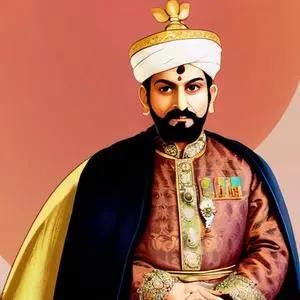
The Mughal emperor who ruled India from 1556 to 1605, known for his military campaigns, administrative reforms, and cultural achievements, including the construction of the Taj Mahal. He was a patron of the arts and a tolerant ruler, fostering a period of cultural and religious harmony.
Akbar, popularly known as Akbar the Great, was the third Mughal emperor, renowned for his military prowess, administrative genius, and cultural achievements. Born on October 15, 1542, in Umerkot, Sindh, Akbar succeeded his father, Humayun, under the regency of Bairam Khan, who played a crucial role in expanding and consolidating Mughal domains in the Indian subcontinent.
Akbar's military campaigns led to the expansion of the Mughal Empire, which eventually encompassed much of the Indian subcontinent. He employed a combination of military might, diplomacy, and strategic marriages to annex neighboring territories, thereby creating a vast and diverse empire. His military campaigns were marked by swift and decisive victories, allowing him to conquer territories that had previously eluded the Mughal Empire.
To unify the vast Mughal state, Akbar introduced a centralized system of administration, dividing the empire into provinces (subahs) governed by appointed governors (subahdars). This system enabled effective governance, revenue collection, and the maintenance of law and order. He also established a uniform system of currency, weights, and measures, facilitating trade and commerce.
Akbar's reign was marked by unprecedented religious tolerance and cultural synthesis. He abolished the sectarian tax (jizya) imposed on non-Muslims, thereby winning their support and loyalty. He also appointed non-Muslims to high civil and military posts, fostering a sense of inclusivity and unity. The Mughal court became a melting pot of cultures, attracting scholars, poets, artists, and architects from diverse backgrounds, leading to the development of a distinct Indo-Persian culture.
Under Akbar's rule, the Mughal Empire experienced unprecedented economic growth, with the economy tripling in size and wealth. This led to commercial expansion, increased patronage of the arts, and architectural innovations. The imperial courts at Delhi, Agra, and Fatehpur Sikri became centers of learning, art, and literature, attracting scholars, poets, and artists from across the empire.
Akbar's disillusionment with orthodox Islam led him to promulgate Din-i-Ilahi, a syncretic creed derived from Islam, Hinduism, Zoroastrianism, and Christianity. This eclectic blend of religious beliefs reflected his desire for religious unity and tolerance within his empire. Akbar's philosophical contributions paved the way for a more inclusive and accepting society.
Akbar's legacy extends beyond his military conquests and administrative reforms. He left an indelible mark on Indian history, fostering a culture of tolerance, inclusivity, and cultural synthesis. The Mughal Empire, during his reign, became a beacon of excellence in arts, literature, and architecture, earning Akbar the title of "the Great". His impact on Indian society and culture continues to be felt to this day.
Akbar's personal life was marked by his love for hunting, archery, and sports. He was known for his physical stamina, courage, and military prowess. According to legend, Akbar was a just ruler, beloved by his subjects, who often referred to him as "Babur's worthy successor".
Akbar's achievements are often compared to those of his contemporaries, such as the Ottoman Sultan Suleiman the Magnificent and the Safavid Shah Abbas I. While these rulers were also renowned for their military conquests and administrative prowess, Akbar's unique blend of military might, cultural tolerance, and administrative genius set him apart from his contemporaries.
Born in 1569
The fourth Mughal emperor, known for his tolerant and artistic reign, patronizing arts and architecture, and expanding the empire through strategic military campaigns.
Born in 1592
The fifth Mughal emperor, who built the iconic Taj Mahal as a mausoleum for his beloved wife, and expanded the empire through military campaigns and architectural achievements.
Born in 1593
The beloved wife of Mughal Emperor Shah Jahan, buried in the stunning white marble mausoleum she inspired, a testament to eternal love and architectural innovation.
Born in 1615
The eldest son of Mughal Emperor Shah Jahan, a philosopher and translator who sought to find common ground between Islam and Hinduism, and translated many Hindu texts into Persian. He was a symbol of religious tolerance and harmony in 17th-century India.
Born in 1618
The Mughal emperor who ruled India from 1658 to 1707, expanding the empire to its greatest extent and implementing Islamic law, while also being known for his architectural achievements, including the Badshahi Mosque.
Born in 1483
The founder of the Mughal Empire, a powerful and culturally rich dynasty that ruled much of India and Pakistan for centuries, known for his military conquests and patronage of the arts.
