


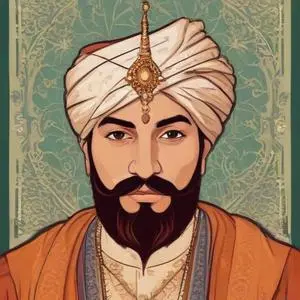
The fourth Mughal emperor, known for his tolerant and artistic reign, patronizing arts and architecture, and expanding the empire through strategic military campaigns.
Known for his majestic rule, artistic endeavors, and complex relationships, Jahangir, the fourth Mughal Emperor, left an indelible mark on Indian history. Reigning from 1605 to 1627, he was a just and fair ruler, fascinated by the arts, particularly painting and architecture, which flourished under his patronage.
Born as Prince Salim on August 31, 1569, in Fatehpur Sikri, Jahangir was the third and only surviving son of Emperor Akbar and his chief empress, Mariam-uz-Zamani. His birth was seen as a fulfillment of the blessings of Sufi saints, Hazrat Ishaan and Salim Chishti, who prophesied the birth of three sons. His early life was marked by personal tragedy, including the death of his twin brothers in infancy, which led to a sense of grief in his family.
Jahangir's reign was a cultural renaissance, marked by a combination of artistic achievement and political intrigue. He was a patron of the arts, and his court attracted scholars, poets, and artists from across the Islamic world. During his reign, the Mughal Empire witnessed significant growth, and he extended his empire's boundaries into the Indian subcontinent, including the Rajput kingdoms and the Deccan.
Jahangir's love for architecture and painting led to the creation of magnificent monuments, including the Mausoleum of Itimad-ud-Daulah, which he built in memory of his father-in-law, Ghiyas Beg. He also commissioned numerous paintings, including the famous "Prince of Wales Museum" album, which showcased the Mughal style of painting.
Jahangir's personal life was marked by a complex relationship with his nobility and family, particularly his marriage to Mehr-un-Nissa, later known as Empress Nur Jahan, who wielded significant political influence behind the throne. Their relationship was marked by power struggles, and Jahangir's subsequent marriages to other women, including Jagat Gosaini, added to the intrigue.
Jahangir's foreign policy was marked by interactions with the Safavids of Persia and the Ottoman Empire, as well as with the English East India Company, marking the beginning of European influence in India. He also engaged in diplomatic efforts to establish trade and cultural relationships with neighboring countries.
Jahangir's legacy is a testament to his commitment to justice, art, and architecture. He was a just ruler, loved by his people, and his patronage of the arts led to a cultural renaissance in the Mughal Empire. His reign marked the beginning of European influence in India, paving the way for future diplomatic and cultural exchanges.
Jahangir was known for his wit and wisdom, often expressing himself through poetry and literature. One of his famous quotes is: "The world is a bridge; pass over it, but build no houses upon it."
Jahangir's story is a testament to the grandeur and complexity of the Mughal Empire, a legacy that continues to inspire and fascinate us to this day.
Born in 1542
The Mughal emperor who ruled India from 1556 to 1605, known for his military campaigns, administrative reforms, and cultural achievements, including the construction of the Taj Mahal. He was a patron of the arts and a tolerant ruler, fostering a period of cultural and religious harmony.
Born in 1592
The fifth Mughal emperor, who built the iconic Taj Mahal as a mausoleum for his beloved wife, and expanded the empire through military campaigns and architectural achievements.
Born in 1618
The Mughal emperor who ruled India from 1658 to 1707, expanding the empire to its greatest extent and implementing Islamic law, while also being known for his architectural achievements, including the Badshahi Mosque.
Born in 1483
The founder of the Mughal Empire, a powerful and culturally rich dynasty that ruled much of India and Pakistan for centuries, known for his military conquests and patronage of the arts.
Born in 1540
A 16th-century Rajput king who fought against the Mughal Empire, known for his bravery and resistance against foreign rule. He is celebrated as a hero in Indian history.
Born in 1750
The 18th-century ruler of the Kingdom of Mysore, known for his military innovations, resistance to British colonization, and patronage of the arts and architecture. He's also famous for his use of rockets in warfare, inspiring the development of modern rocketry.
