


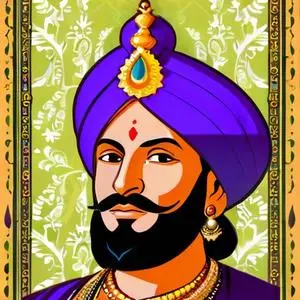
The fifth Mughal emperor, who built the iconic Taj Mahal as a mausoleum for his beloved wife, and expanded the empire through military campaigns and architectural achievements.
Shah Jahan, the fifth Mughal emperor, is renowned for his extravagant architectural legacy, including the iconic Taj Mahal, a testament to his love for his beloved wife, Mumtaz Mahal. During his reign from 1628 to 1658, the Mughal Empire reached its peak of cultural and architectural achievements, making him one of the most celebrated emperors in Indian history.
Born on January 5, 1592, as Mirza Shahabuddin Muhammad Khurram, Shah Jahan was the third son of Jahangir, the fourth Mughal emperor. He participated in several military campaigns, including those against the Sisodia Rajputs of Mewar and the rebel Lodi nobles of the Deccan, demonstrating his military prowess and strategic thinking.
Shah Jahan's reign was marked by an unprecedented cultural and architectural renaissance. He commissioned numerous monumental structures, including:
These architectural marvels showcased Shah Jahan's passion for art, architecture, and aesthetics, earning him the title "King of the World."
Shah Jahan expanded the Mughal Empire through a series of military campaigns, including:
These military achievements solidified Shah Jahan's position as a skilled military strategist and a master of foreign policy.
In September 1657, Shah Jahan appointed his eldest son, Dara Shikoh, as his successor, sparking a succession crisis among his three sons. Aurangzeb, Shah Jahan's third son, eventually emerged victorious and became the sixth Mughal emperor, imprisoning his father in the Agra Fort until his death in January 1666.
Shah Jahan's reign left an indelible mark on Indian history, cementing the Mughal Empire's position as a beacon of cultural and architectural excellence. His architectural legacy continues to inspire wonder and awe, making him one of the most celebrated emperors in Indian history.
Today, Shah Jahan's magnificent creations stand as testaments to his unwavering passion for art, architecture, and beauty, ensuring his place as one of the most iconic figures in Indian history.
Born in 1593
The beloved wife of Mughal Emperor Shah Jahan, buried in the stunning white marble mausoleum she inspired, a testament to eternal love and architectural innovation.
Born in 1618
The Mughal emperor who ruled India from 1658 to 1707, expanding the empire to its greatest extent and implementing Islamic law, while also being known for his architectural achievements, including the Badshahi Mosque.
Born in 1542
The Mughal emperor who ruled India from 1556 to 1605, known for his military campaigns, administrative reforms, and cultural achievements, including the construction of the Taj Mahal. He was a patron of the arts and a tolerant ruler, fostering a period of cultural and religious harmony.
Born in 1569
The fourth Mughal emperor, known for his tolerant and artistic reign, patronizing arts and architecture, and expanding the empire through strategic military campaigns.
Born in 1483
The founder of the Mughal Empire, a powerful and culturally rich dynasty that ruled much of India and Pakistan for centuries, known for his military conquests and patronage of the arts.
Born in 1540
A 16th-century Rajput king who fought against the Mughal Empire, known for his bravery and resistance against foreign rule. He is celebrated as a hero in Indian history.
