


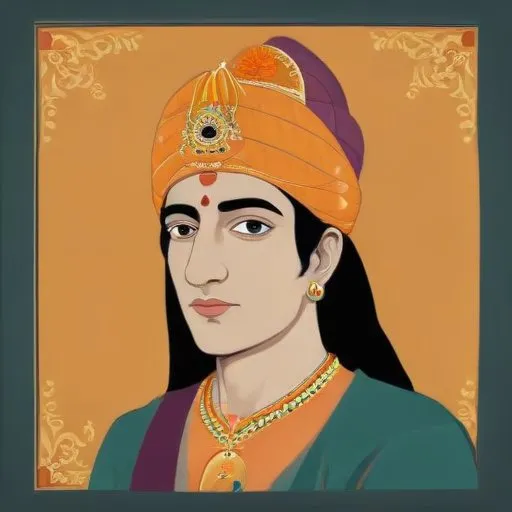
The eldest son of Mughal Emperor Shah Jahan, a philosopher and translator who sought to find common ground between Islam and Hinduism, and translated many Hindu texts into Persian. He was a symbol of religious tolerance and harmony in 17th-century India.
Dara Shikoh, the eldest son of Mughal Emperor Shah Jahan, is renowned for his liberal and unorthodox approach to Islam, as well as his remarkable work, "The Confluence of the Two Seas", which pioneered the harmony between Sufi philosophy in Islam and Vedanta philosophy in Hinduism. As a mystic, philosopher, and patron of the arts, Dara Shikoh's legacy continues to inspire and intrigue scholars and historians alike.
Born on 11 March 1615 in Ajmer, Rajasthan, Dara Shikoh was the first son and third child of Prince Shahibuddin Muhammad Khurram and his second wife, Mumtaz Mahal. His name, meaning "owner of wealth" or "star" in Persian, was given by his father. Dara Shikoh had thirteen siblings, six of whom survived to adulthood, including his younger sister, Jahanara Begum, with whom he shared a close relationship.
Dara Shikoh's love for philosophy, mysticism, and the arts led him to become a generous patron, encouraging scholars, poets, and artists to flourish under his patronage. His own philosophical works, including "The Confluence of the Two Seas", showcased his unique perspective on the harmony between Islam and Hinduism, earning him recognition as a visionary thinker.
In 1657, when Shah Jahan fell ill, Dara Shikoh was designated as his successor, much to the dismay of his younger brother, Prince Muhiuddin (later Emperor Aurangzeb). The subsequent war of succession ultimately led to Dara Shikoh's defeat and execution in 1659, at the hands of Aurangzeb. This tragic event had a profound impact on the course of Indian history, leaving historians to ponder the possibilities of a Dara Shikoh-led empire.
Dara Shikoh's most notable contribution was his groundbreaking work, "The Confluence of the Two Seas", which aimed to reconcile the differences between Sufi philosophy in Islam and Vedanta philosophy in Hinduism. This pioneering effort reflected his deep understanding of both faiths and his desire to promote harmony and coexistence.
The execution of Dara Shikoh marked a significant turning point in Indian history, leading to the rise of Aurangzeb's orthodox and repressive regime. Nevertheless, Dara Shikoh's legacy continues to inspire scholars, philosophers, and artists, offering a glimpse into a potential era of harmony and coexistence between different faiths.
In contrast to Aurangzeb's rigid orthodoxy, Dara Shikoh's liberal and inclusive approach to Islam set him apart from his contemporaries. His willingness to engage with diverse philosophical traditions and promote artistic expression distinguishes him as a visionary leader, ahead of his time.
Dara Shikoh's extraordinary life and legacy continue to captivate historians, philosophers, and art enthusiasts, serving as a powerful reminder of the transformative power of harmony, coexistence, and intellectual curiosity.
Born in 1593
The beloved wife of Mughal Emperor Shah Jahan, buried in the stunning white marble mausoleum she inspired, a testament to eternal love and architectural innovation.
Born in 1592
The fifth Mughal emperor, who built the iconic Taj Mahal as a mausoleum for his beloved wife, and expanded the empire through military campaigns and architectural achievements.
Born in 1618
The Mughal emperor who ruled India from 1658 to 1707, expanding the empire to its greatest extent and implementing Islamic law, while also being known for his architectural achievements, including the Badshahi Mosque.
Born in 1828
The last queen of Jhansi, a fierce warrior and leader, led a rebellion against British colonial rule in India, becoming a symbol of resistance and patriotism.
Born in 1904
The second Prime Minister of India, leading the country through a tumultuous period, including a war with Pakistan, and known for his simplicity, honesty, and dedication to the nation. He is also credited with promoting the Green Revolution, which transformed India's agricultural sector.
