


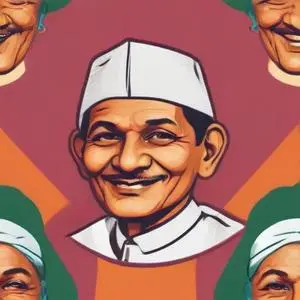
The second Prime Minister of India, leading the country through a tumultuous period, including a war with Pakistan, and known for his simplicity, honesty, and dedication to the nation. He is also credited with promoting the Green Revolution, which transformed India's agricultural sector.
Lal Bahadur Shastri, India's second Prime Minister, is renowned for spearheading the country's Green Revolution and White Revolution, which transformed India's food production and dairy industries. His remarkable leadership and vision enabled India to achieve self-sufficiency in food grain production and become a major player in the dairy industry.
Born on October 2, 1904, in Mughalsarai, Uttar Pradesh, Shastri was deeply influenced by the philosophies of Swami Vivekananda, Mahatma Gandhi, and Annie Besant. He was drawn to the Indian Independence movement in the 1920s, and his association with Gandhi played a significant role in shaping his thoughts and actions.
Shastri's involvement in the Indian National Congress and his presidency of the Servants of the People Society (Lok Sevak Mandal) founded by Lala Lajpat Rai, enabled him to hold prominent positions in the Indian government after independence in 1947. He served as Railways Minister (1951-1956) and then as Home Minister, earning recognition as one of Prime Minister Nehru's key cabinet colleagues.
As Prime Minister from 1964 to 1966, Shastri launched the White Revolution, a national campaign to increase milk production and supply. He supported the Amul milk cooperative in Anand, Gujarat, and established the National Dairy Development Board. This initiative led to a significant increase in milk production, making India self-sufficient in dairy products.
Shastri also promoted the Green Revolution in 1965, which aimed to boost India's food grain production. He introduced high-yielding varieties of wheat and rice, leading to a substantial increase in food grain production, particularly in the states of Punjab, Haryana, and Uttar Pradesh.
During the Second India-Pakistan War, Shastri's leadership played a crucial role in India's victory. His popular slogan "Jai Jawan, Jai Kisan" (Hail to the soldier, Hail to the farmer) became a rallying cry for the nation.
Lal Bahadur Shastri's legacy extends beyond his remarkable achievements as a Prime Minister. He is remembered for his simplicity, humility, and dedication to the welfare of the common man. His vision for India's development continues to inspire generations, making him one of India's most revered leaders.
"We believe in the dignity of the individual, in his freedom, in his capacity to make choices, and in his right to live a life of his own choosing."
"Jai Jawan, Jai Kisan" (Hail to the soldier, Hail to the farmer)
These quotes and sayings reflect Shastri's commitment to the welfare of the common man and his vision for India's development.
Lal Bahadur Shastri's tenure as Prime Minister was marked by significant events, including the Second India-Pakistan War and the Indo-Pakistani War of 1965. His leadership during these challenging times has earned him a place in Indian history as a statesman and a visionary leader.
Shastri's legacy extends beyond his political achievements to encompass his contributions to India's social and economic development. His commitment to the welfare of the common man and his vision for India's self-sufficiency continue to inspire future generations.
Born in 1889
India's first Prime Minister, a key figure in the country's struggle for independence from British rule, and a champion of democracy and secularism. He played a crucial role in shaping modern India's government and economy.
Born in 1917
The first female Prime Minister of India, serving from 1966 to 1977 and again from 1980 until her assassination in 1984, known for her strong leadership and economic reforms.
Born in 1884
India's first president, a key figure in the country's struggle for independence, who played a crucial role in shaping the nation's early years. He's revered for his leadership and commitment to democracy.
Born in 1896
Fourth Prime Minister of India, known for his efforts to decentralize power and promote economic development, and for being the first Indian Prime Minister to resign from office.
Born in 1898
Indian politician who served as the Acting Prime Minister of India twice, known for his leadership during critical periods of Indian history.
Born in 1902
The 5th Prime Minister of India, a champion of rural development and social justice, who implemented land reforms and empowered farmers. He played a crucial role in shaping India's agricultural sector and economy.
