


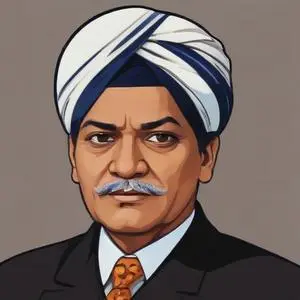
India's first president, a key figure in the country's struggle for independence, who played a crucial role in shaping the nation's early years. He's revered for his leadership and commitment to democracy.
Rajendra Prasad, the first President of India, was a stalwart of the Indian independence movement, a champion of Mahatma Gandhi's ideals, and a pioneering leader who played a crucial role in shaping the country's destiny. As a lawyer, journalist, and scholar, Prasad's multifaceted personality and unwavering commitment to the nation's cause earned him a revered place in Indian history.
Born on December 3, 1884, in Ziradei, Bihar, Prasad hailed from a Chitraguptavanshi Kayastha family. His father, Mahadev Sahay Srivastava, was a scholar of Sanskrit and Persian languages, while his mother, Kamleshwari Devi, was a devout woman who instilled in him the values of India's rich cultural heritage. After completing his early education in Bihar, Prasad moved to Calcutta to pursue his higher studies.
Prasad's involvement in the Indian independence movement began in the 1920s, when he joined the Indian National Congress. He was drawn to Mahatma Gandhi's philosophy of non-violent resistance and soon became one of his most trusted lieutenants. Prasad was imprisoned by British authorities during the Salt Satyagraha of 1930 and the Quit India movement of 1942, but his unwavering commitment to the cause remained unbroken.
After India gained independence in 1947, Prasad was elected as the President of the Constituent Assembly, which drafted the country's Constitution. In 1950, he was elected as the first President of India, a position he held until 1962. During his presidency, Prasad established a tradition of non-partisanship and independence, advising the government on several occasions and encouraging the development of education in India.
Rajendra Prasad's legacy is a testament to his vision and leadership. He played a pivotal role in shaping India's destiny, from fighting for independence to drafting the country's Constitution. His commitment to education and his efforts to promote economic development continue to inspire generations of Indians. Prasad's unwavering dedication to the nation's cause has earned him a revered place in Indian history.
"The Constitution is the sole basis of the existence of our Government. If we destroy or impair its authority, we shake the foundations of our State."
Rajendra Prasad's life is a testament to his unwavering commitment to the nation's cause. His legacy continues to inspire generations of Indians, and his contribution to the country's freedom and development remains unparalleled.
Born in 1889
India's first Prime Minister, a key figure in the country's struggle for independence from British rule, and a champion of democracy and secularism. He played a crucial role in shaping modern India's government and economy.
Born in 1869
Indian freedom fighter, activist, and philosopher who led India to independence from British rule through non-violent civil disobedience, inspiring civil rights movements worldwide.
Born in 1917
The first female Prime Minister of India, serving from 1966 to 1977 and again from 1980 until her assassination in 1984, known for her strong leadership and economic reforms.
Born in 1888
An Indian philosopher and politician who served as the 2nd President of India, known for his influential writings on Indian philosophy and his role in shaping India's education system.
Born in 1878
The first Indian Governor-General of India, serving from 1948 to 1950, and a key figure in the country's struggle for independence from British rule. He was a strong advocate for non-violent resistance and played a crucial role in shaping India's early years.
Born in 1875
Indian lawyer and politician who played a key role in India's struggle for independence and later became the country's first Deputy Prime Minister, known for his strong leadership and unification of the country.
Born in 1887
The first Chief Minister of Uttar Pradesh, a key figure in India's struggle for independence, and a champion of social reform and education. He played a crucial role in shaping India's post-independence era.
Born in 1896
Fourth Prime Minister of India, known for his efforts to decentralize power and promote economic development, and for being the first Indian Prime Minister to resign from office.
