


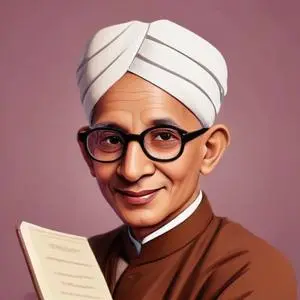
An Indian philosopher and politician who served as the 2nd President of India, known for his influential writings on Indian philosophy and his role in shaping India's education system.
Sarvepalli Radhakrishnan, one of the most influential and distinguished scholars of the 20th century, is revered for his vast contributions to the fields of philosophy, politics, and education. As the second President of India, he played a pivotal role in shaping the country's growth and identity, earning him the esteemed title of "Philosopher-President" of India.
Born on September 5, 1888, in a Telugu Niyogi Brahmin family in southern India, Radhakrishnan was the second of three siblings. His early education took place in local schools, where he developed a strong foundation in Hindu scriptures and classical Indian languages. He later pursued higher education at the University of Madras, earning his M.A. in Philosophy in 1909.
Radhakrishnan's academic journey began as a professor of philosophy at the University of Madras, where he taught for 16 years. During this period, he authored several books on philosophy, including his magnum opus, "The Philosophy of Rabindranath Tagore." His unique interpretation of Indian philosophy, particularly Advaita Vedanta, earned him international recognition.
In 1931, Radhakrishnan became the Vice-Chancellor of Andhra University, a position he held until 1936. He then served as the Vice-Chancellor of Banaras Hindu University from 1939 to 1948. During his tenure, he implemented innovative educational reforms, emphasizing the importance of Indian philosophy and culture.
In addition to his academic pursuits, Radhakrishnan was a devoted philanthropist. He co-founded Helpage India, a non-profit organization dedicated to supporting elderly underprivileged individuals in India.
Radhakrishnan's philosophical contributions were rooted in Advaita Vedanta, which he reinterpreted for a contemporary understanding. He defended Hinduism against Western criticism, contributing to the formation of modern Hindu identity. His philosophy emphasized the importance of spiritual growth, self-realization, and the unity of all existence.
Radhakrishnan's foray into politics began in 1949, when he became the second Ambassador of India to the Soviet Union. In 1952, he was appointed as the first Vice-President of India, a position he held until 1962. He then assumed the office of the second President of India, serving from 1962 to 1967.
During his presidency, Radhakrishnan played a crucial role in shaping India's foreign policy, particularly in the context of the Cold War era. He was a strong advocate for non-alignment and democracy, earning him international recognition and respect.
Radhakrishnan was awarded numerous prestigious awards and honors for his contributions to philosophy, politics, and education. Some notable recognition includes:
Sarvepalli Radhakrishnan's legacy extends far beyond his political and academic achievements. He is revered as a bridge between India and the West, having contributed significantly to the global understanding of Indian philosophy and culture.
In recognition of his immense contributions to education, Radhakrishnan's birthday, September 5, is celebrated as Teachers' Day in India. His philosophy and ideals continue to inspire generations of scholars, educators, and leaders worldwide.
In conclusion, Sarvepalli Radhakrishnan's remarkable life and achievements serve as a testament to his unwavering dedication to philosophy, education, and public service. His contributions continue to shape modern India and inspire a new generation of leaders, earning him a permanent place in the annals of Indian history.
Born in 1889
India's first Prime Minister, a key figure in the country's struggle for independence from British rule, and a champion of democracy and secularism. He played a crucial role in shaping modern India's government and economy.
Born in 1869
Indian freedom fighter, activist, and philosopher who led India to independence from British rule through non-violent civil disobedience, inspiring civil rights movements worldwide.
Born in 1917
The first female Prime Minister of India, serving from 1966 to 1977 and again from 1980 until her assassination in 1984, known for her strong leadership and economic reforms.
Born in 1884
India's first president, a key figure in the country's struggle for independence, who played a crucial role in shaping the nation's early years. He's revered for his leadership and commitment to democracy.
Born in 1896
Fourth Prime Minister of India, known for his efforts to decentralize power and promote economic development, and for being the first Indian Prime Minister to resign from office.
Born in 1897
The 3rd President of India, a scholar and statesman, played a crucial role in shaping the country's education system and promoting secular values. He was a strong advocate for social justice and equality.
Born in 1894
The fourth President of India, a lawyer and politician who played a key role in India's independence movement and later served as the country's head of state. He's known for his strong leadership and commitment to social justice.
Born in 1913
The 6th President of India, a lawyer-turned-politician who played a significant role in India's independence movement and later served as the country's head of state. He's most known for his humble and unassuming leadership style.
