


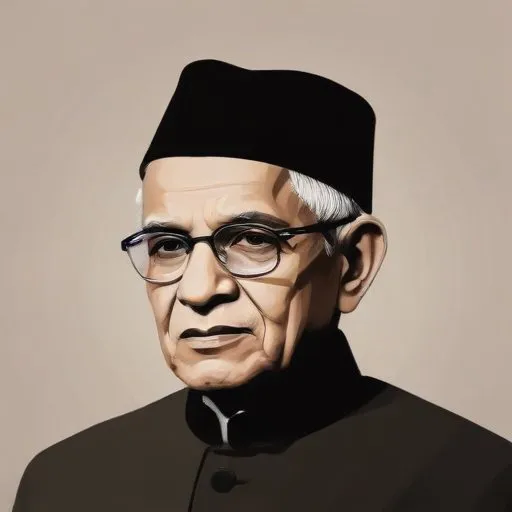
The 3rd President of India, a scholar and statesman, played a crucial role in shaping the country's education system and promoting secular values. He was a strong advocate for social justice and equality.
Zakir Husain, the third President of India, was a renowned educationist, politician, and economist who left an indelible mark on the country's educational landscape and politics. He is best known for his unwavering dedication to education, his role in shaping modern India, and his remarkable journey from being a humble student to the highest constitutional office in the land.
Born on February 8, 1897, in Hyderabad, India, Zakir Husain came from an Afridi Pashtun family. He completed his schooling in Etawah and later attended the Muhammadan Anglo-Oriental College in Aligarh. His thirst for knowledge took him to the University of Berlin, where he earned a doctoral degree in economics.
A close associate of Mahatma Gandhi, Husain was a founding member of the Jamia Millia Islamia, which was established in response to the Non-cooperation movement. He served as the university's vice-chancellor from 1926 to 1948.
In 1937, he chaired the Basic National Education Committee, which framed a new educational policy known as Nai Talim, emphasizing free and compulsory education in the first language.
He was a strong opponent of separate electorates for Muslims and Played a crucial role in retaining the Aligarh Muslim University as a national institution of higher learning after India's Independence and Partition.
Zakir Husain's contributions to education and politics earned him numerous accolades, including the prestigious Padma Vibhushan in 1954 and the Bharat Ratna in 1963. He was also a nominated member of the Indian Parliament from 1952 to 1957.
In 1957, Husain became the Governor of Bihar, a position he held until 1962. The following year, he was elected Vice President of India and, in 1967, he succeeded Sarvepalli Radhakrishnan as the President of India, becoming the first Muslim to hold the highest constitutional office in the country.
Zakir Husain's legacy extends far beyond his political achievements. He played a pivotal role in shaping India's education system, emphasizing the importance of education in the first language and making it accessible to all. His commitment to education and nation-building continues to inspire generations of Indians.
Today, his mazar (tomb) stands as a symbol of reverence and respect in the campus of the Jamia Millia Islamia in Delhi, a testament to his enduring legacy.
Born in 1889
India's first Prime Minister, a key figure in the country's struggle for independence from British rule, and a champion of democracy and secularism. He played a crucial role in shaping modern India's government and economy.
Born in 1917
The first female Prime Minister of India, serving from 1966 to 1977 and again from 1980 until her assassination in 1984, known for her strong leadership and economic reforms.
Born in 1884
India's first president, a key figure in the country's struggle for independence, who played a crucial role in shaping the nation's early years. He's revered for his leadership and commitment to democracy.
Born in 1888
An Indian philosopher and politician who served as the 2nd President of India, known for his influential writings on Indian philosophy and his role in shaping India's education system.
Born in 1894
The fourth President of India, a lawyer and politician who played a key role in India's independence movement and later served as the country's head of state. He's known for his strong leadership and commitment to social justice.
Born in 1905
The 5th President of India, a lawyer and politician who played a crucial role in the country's politics during the 1970s, and is remembered for his efforts to maintain national unity and stability.
Born in 1913
The 6th President of India, a lawyer-turned-politician who played a significant role in India's independence movement and later served as the country's head of state. He's most known for his humble and unassuming leadership style.
Born in 1916
The first Sikh to hold the office, he served as President of India from 1982 to 1987, playing a crucial role in maintaining national stability during a tumultuous period. He's also remembered for his humble beginnings and rise to prominence.
