


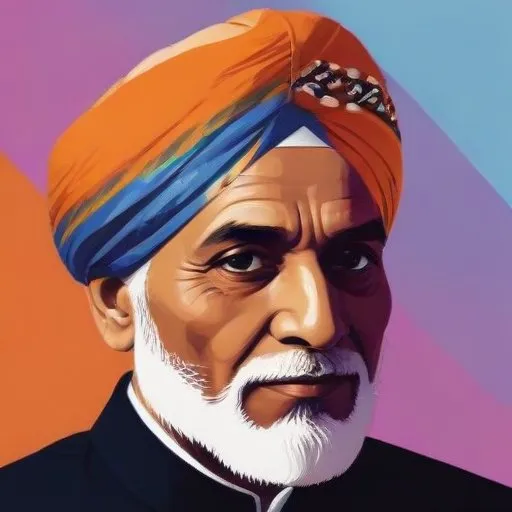
The first Sikh to hold the office, he served as President of India from 1982 to 1987, playing a crucial role in maintaining national stability during a tumultuous period. He's also remembered for his humble beginnings and rise to prominence.
Giani Zail Singh, India's seventh President from 1982 to 1987, was a trailblazing figure who etched his name in the country's annals of history. As the first Sikh to assume the highest office, Singh's remarkable journey was marked by his unwavering commitment to social justice, land reforms, and education.
Born Jarnail Singh on May 5, 1916, in the princely state of Faridkot, Punjab, Singh was drawn to the world of spirituality and learning from an early age. He trained to be a granthi, earning the title of Giani, which means a learned man, at the Sikh Missionary School in Amritsar.
Singh's early foray into politics began with his involvement in peasant agitations and the movement seeking a representative government in Faridkot. His activism earned him a stint in solitary confinement between 1938 and 1943, where he began to contemplate his name change to Zail Singh. Upon release, he led a flag satyagraha and formed a parallel government in Faridkot State, which was eventually dissolved after the intervention of Jawaharlal Nehru and Vallabhbhai Patel.
After India's independence, Faridkot was merged with the Patiala and East Punjab States Union, and Singh served as its minister of revenue and agriculture from 1949 to 1951. He oversaw the introduction of landmark land reforms in Punjab, setting the stage for his future endeavors. Later, as chief minister of Punjab from 1972 to 1977, Singh established India's first semiconductor manufacturing unit in Mohali and spearheaded the Punjab Land Reforms Act of 1972.
Singh's commitment to social justice was unwavering, as evidenced by his efforts to ensure reservation for Mazhabi Sikhs and Valmikis in education and public employment. He also facilitated the repatriation of the remains of Udham Singh, a revolutionary who fought for Indian independence, and accorded him a state funeral.
Giani Zail Singh's remarkable journey, marked by his unrelenting pursuit of land reforms, education, and social justice, has left an indelible mark on India's history. As the country's first Sikh President, his legacy serves as a beacon of hope for generations to come, inspiring them to strive for a more equitable and just society.
Born in 1917
The first female Prime Minister of India, serving from 1966 to 1977 and again from 1980 until her assassination in 1984, known for her strong leadership and economic reforms.
82 Years Old
The 6th Prime Minister of India, a key figure in Indian politics, known for introducing economic reforms and promoting technology in the country. He was also a strong advocate for social justice and equality.
79 Years Old
The first female President of the Indian National Congress, leading the party to a landslide victory in 2004, and playing a crucial role in shaping India's political landscape.
94 Years Old
The 13th Prime Minister of India, a renowned economist who led the country through a period of rapid economic growth and liberalization, implementing reforms that transformed India's economy. He is credited with helping to lift millions of people out of poverty.
Born in 1889
India's first Prime Minister, a key figure in the country's struggle for independence from British rule, and a champion of democracy and secularism. He played a crucial role in shaping modern India's government and economy.
Born in 1904
The second Prime Minister of India, leading the country through a tumultuous period, including a war with Pakistan, and known for his simplicity, honesty, and dedication to the nation. He is also credited with promoting the Green Revolution, which transformed India's agricultural sector.
Born in 1896
Fourth Prime Minister of India, known for his efforts to decentralize power and promote economic development, and for being the first Indian Prime Minister to resign from office.
Born in 1902
The 5th Prime Minister of India, a champion of rural development and social justice, who implemented land reforms and empowered farmers. He played a crucial role in shaping India's agricultural sector and economy.
