


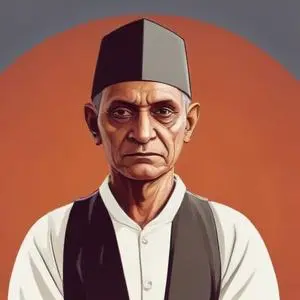
Indian lawyer and politician who played a key role in India's struggle for independence and later became the country's first Deputy Prime Minister, known for his strong leadership and unification of the country.
Vallabhbhai Patel, also known as Sardar Patel, was a pivotal figure in India's struggle for independence, serving as the country's first Deputy Prime Minister and Home Minister from 1947 to 1950. He played a crucial role in integrating India's numerous princely states, earning him the title of the "Iron Man of India."
Born on October 31, 1875, in Nadiad, Gujarat, Patel grew up in a farming family and was raised in the countryside of Gujarat. He graduated from the Middle Temple in London, where he studied law, and returned to India in 1899 to practice as a barrister.
Patel's entry into politics was sparked by his encounter with Mahatma Gandhi, who inspired him to join the Indian independence movement. He became one of Gandhi's earliest lieutenants and organized peasants in Gujarat to participate in non-violent civil disobedience against the British Raj. This led to Patel becoming a prominent leader in Gujarat and eventually, one of the most influential leaders in the Indian National Congress.
Patel's most notable contributions include:
Patel was a strong advocate for Gandhi's philosophy of non-violent resistance and civil disobedience. He believed in the power of non-violent struggle to achieve independence and social justice. Patel's philosophy was also influenced by his strong roots in Indian nationalism and his commitment to the idea of a unified Indian state.
Some notable milestones in Patel's life include:
Patel's legacy has had a profound impact on modern Indian society. He is remembered as a unifying force, who brought together the diverse princely states and forged a unified Indian nation. His commitment to non-violent resistance and civil disobedience continues to inspire social and political movements across the world.
Today, Patel is remembered as one of India's most revered leaders, and his birthday, October 31, is celebrated as Rashtriya Ekta Diwas (National Unity Day). His legacy continues to inspire generations of Indians and people around the world, and his contributions to India's independence and integration remain unparalleled.
Born in 1889
India's first Prime Minister, a key figure in the country's struggle for independence from British rule, and a champion of democracy and secularism. He played a crucial role in shaping modern India's government and economy.
Born in 1869
Indian freedom fighter, activist, and philosopher who led India to independence from British rule through non-violent civil disobedience, inspiring civil rights movements worldwide.
Born in 1897
Indian freedom fighter and politician who led the Indian National Army against British rule and was a key figure in the country's struggle for independence. He is also known for his mysterious disappearance in 1945.
Born in 1904
The second Prime Minister of India, leading the country through a tumultuous period, including a war with Pakistan, and known for his simplicity, honesty, and dedication to the nation. He is also credited with promoting the Green Revolution, which transformed India's agricultural sector.
Born in 1896
Fourth Prime Minister of India, known for his efforts to decentralize power and promote economic development, and for being the first Indian Prime Minister to resign from office.
Born in 1917
The first female Prime Minister of India, serving from 1966 to 1977 and again from 1980 until her assassination in 1984, known for her strong leadership and economic reforms.
Born in 1884
India's first president, a key figure in the country's struggle for independence, who played a crucial role in shaping the nation's early years. He's revered for his leadership and commitment to democracy.
Born in 1888
A key figure in India's struggle for independence, he played a crucial role in shaping the country's education system and promoting unity among its diverse population.
