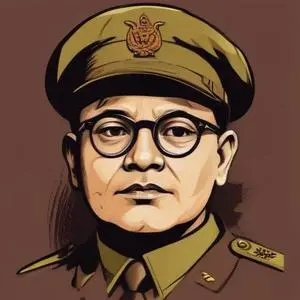
Subhas Chandra Bose: The Fearless Nationalist
A Life of Defiance and Leadership
Subhas Chandra Bose is remembered as a fearless Indian nationalist who dared to challenge the British Raj, inspiring a generation of Indians to fight for their country's independence. His unwavering dedication to the cause earned him the honorific title "Netaji" (Respected Leader), a name that resonates with reverence across India.
Early Life and Education
Born on January 23, 1897, in Cuttack, Orissa, Bose was raised in a wealthy Bengali family during the British Raj. He received an Anglocentric education, which laid the foundation for his later nationalist stance. After completing his education in India, he traveled to England to take the Indian Civil Service examination, which he passed with distinction in 1920.
Rise to Prominence
Upon returning to India in 1921, Bose joined the Indian National Congress, led by
Mahatma Gandhi, and quickly rose through the ranks. He became Congress president in 1938, and his leadership style, which blended socialism and nationalism, gained him a massive following. Bose's vision for India's future federation of British India and princely states, however, led to differences with Congress leaders, including Gandhi, and ultimately resulted in his resignation as president in 1939.
Seeking Allies Abroad
In April 1941, Bose arrived in Nazi Germany, where he received unexpected sympathy for India's independence from the German leadership. With German funds, he established the Free India Centre in Berlin and formed the 3,000-strong Free India Legion. This move was met with controversy, as Bose's alliance with the Axis powers was seen as a pragmatic, if not problematic, means to an end.
Philosophical Contributions and Beliefs
Bose's philosophical stance was rooted in socialism, nationalism, and a deep sense of justice. He believed in the power of armed struggle to achieve independence, and his writings often emphasized the need for sacrifice and discipline. Bose's views on swaraj (self-rule) and socialism influenced a generation of Indian leaders, including
Jawaharlal Nehru.
Personal Milestones and Key Life Events
- 1930: Bose was arrested and imprisoned for his role in the Salt March, a non-violent protest against British taxation.
- 1938: Bose became the Congress president, marking a significant milestone in his rise to national prominence.
- 1941: Bose escaped from British India, traveling to Berlin to seek German support for India's independence.
- 1943: Bose formed the Azad Hind (Free India) government in Singapore, which was recognized by several countries, including Germany, Italy, and Japan.
- 1945: Bose's alleged death in a plane crash in Taipei, Taiwan, on August 18, 1945, remains shrouded in mystery and controversy.
Influence on Modern Society
Subhas Chandra Bose's legacy continues to inspire Indians and non-Indians alike. His unwavering commitment to India's independence serves as a beacon of hope for those fighting against oppression. Bose's influence can be seen in India's secular democracy, which was shaped by his socialist and nationalist ideals.
Quotes and Memorable Sayings
- "Give me blood, and I shall give you freedom."
- "Freedom is not given, it is taken."
- "One individual may die for an idea, but that idea will, after his death, incarnate itself in a thousand lives."
Legacy and Controversy
Bose's wartime alliances with Nazi Germany and Imperial Japan have sparked controversy, with some critics accusing him of authoritarianism and anti-Semitism. However, his contribution to India's struggle for independence remains undeniable. As a national hero, Bose's legacy continues to inspire Indians to fight for their rights and freedoms.
FAQ
What was Subhas Chandra Boses role in the Indian independence movement?
Subhas Chandra Bose was a key leader in the Indian independence movement, who believed in armed struggle against British rule. He formed the Indian National Army and led it against the British during World War II.
What was Subhas Chandra Boses ideology?
Subhas Chandra Boses ideology was a mix of socialism, fascism, and nationalism. He believed in a robust and self-sufficient India, free from British rule.
What was Subhas Chandra Boses relationship with Mahatma Gandhi?
Subhas Chandra Bose was a protégé of Mahatma Gandhi, but he later disagreed with Gandhis non-violent approach to achieving independence.
What was the Azad Hind Government?
The Azad Hind Government was a provisional government established by Subhas Chandra Bose in 1943, with the aim of liberating India from British rule.
What is Subhas Chandra Boses legacy in Indian history?
Subhas Chandra Boses legacy in Indian history is that of a brave and visionary leader who fought for Indias independence. He is remembered as a national hero and a symbol of resistance against colonial rule.