


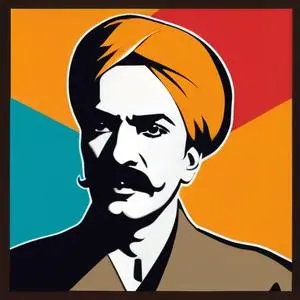
An Indian socialist revolutionary who fought for independence from British rule through dramatic acts of defiance, including a bombing of the Indian Assembly and a hunger strike that led to his execution.
Bhagat Singh is renowned for his fearless struggle against British colonial rule in India, which ultimately led to his execution at the tender age of 23. His bravery and sacrifice transformed him into a martyr and a folk hero in Northern India, inspiring a generation of freedom fighters.
Born on September 28, 1907, in Lyallpur, Punjab (now in Pakistan), Bhagat Singh was exposed to the ideals of Indian nationalism from a young age. His family, particularly his uncle and father, played a significant role in shaping his political views. Singh's fascination with the Russian Revolution and the works of Lenin, Marx, and Trotsky further solidified his commitment to the cause of Indian independence.
In December 1928, Bhagat Singh, along with Shivaram Rajguru, shot dead British police officer John Saunders in Lahore, mistaking him for the senior superintendent James Scott. This act of defiance was in retaliation for Scott's role in the death of Indian nationalist leader Lala Lajpat Rai. The Hindustan Socialist Republican Association (HSRA), a small revolutionary group, claimed responsibility for the assassination.
In April 1929, Bhagat Singh and his accomplice Batukeshwar Dutt bombed the Central Legislative Assembly in Delhi, a largely symbolic act aimed at highlighting the struggle for Indian independence. Singh and Dutt were arrested and put on trial, during which they undertook a 116-day hunger strike to protest the mistreatment of Indian prisoners. This brave stance garnered widespread sympathy and attention from the Indian press, catapulting Singh into a household name in the Punjab region.
Bhagat Singh's intellectual curiosity and exposure to various ideologies, including Bolshevism and anarchism, greatly influenced his thoughts on revolution and social change. He believed in the power of armed revolution to overthrow colonial rule and establish a socialist India. Singh's writings, particularly his tract "Why I Am an Atheist," showcase his rational and humanist worldview.
Bhagat Singh's execution on March 23, 1931, led to widespread outrage and protests across India. His sacrifice and martyrdom galvanized the Indian independence movement, prompting introspection within the Indian National Congress and its nonviolent campaign for independence. Singh's legacy extends far beyond his revolutionary actions, inspiring countless Indians to fight for their rights and freedom.
"They may kill me, but they cannot kill my ideas. They may crush my body, but they will not be able to crush my spirit."
"It is easy to kill individuals, but you cannot kill the ideas."
Bhagat Singh's life and struggle unfolded against the backdrop of British colonial rule in India, a period marked by repression, exploitation, and nationalist fervor. His sacrifice and martyrdom continue to inspire Indians and people around the world, serving as a powerful reminder of the importance of fighting for one's rights and freedom.
Born in 1869
Indian freedom fighter, activist, and philosopher who led India to independence from British rule through non-violent civil disobedience, inspiring civil rights movements worldwide.
Born in 1889
India's first Prime Minister, a key figure in the country's struggle for independence from British rule, and a champion of democracy and secularism. He played a crucial role in shaping modern India's government and economy.
Born in 1897
Indian freedom fighter and politician who led the Indian National Army against British rule and was a key figure in the country's struggle for independence. He is also known for his mysterious disappearance in 1945.
Born in 1865
A leading figure in India's struggle for independence from British rule, known for his role in the Indian independence movement and his advocacy for Hindu-Muslim unity.
Born in 1906
A fearless Indian revolutionary who fought against British colonial rule, known for his bravery and sacrifice in the struggle for independence.
Born in 1907
Indian revolutionary and freedom fighter who fought against British colonial rule, known for his involvement in the Lahore Conspiracy Case and his execution at a young age.
74 Years Old
A Malaysian professional footballer who played as a midfielder and earned 12 international caps for the Malaysia national team between 2002 and 2007. He's remembered for his stint with Selangor FA in the Malaysian Super League.
Born in 1908
Indian revolutionary who fought for independence from British rule, known for his role in the assassination of a British police officer in 1928.
