


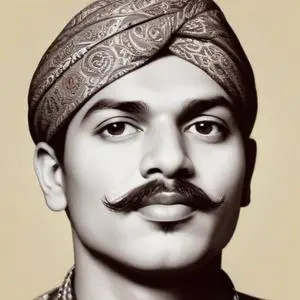
A fearless Indian revolutionary who fought against British colonial rule, known for his bravery and sacrifice in the struggle for independence.
Known for his unwavering commitment to the freedom of India, Chandra Shekhar Azad was a prominent revolutionary who played a pivotal role in the country's struggle for independence. His bravery and sacrifice continue to inspire generations, earning him the reputation as one of India's most revered freedom fighters.
Chandra Shekhar Azad was born on July 23, 1906, in Bhabhra village, Unnao district, Uttar Pradesh, to a Brahmin family. His parents, Sitaram Tiwari and Jagrani Devi, instilled in him a strong sense of patriotism and desire for education. Azad's early years were marked by a fascination with Sanskrit and Hindu scriptures, which laid the foundation for his future commitment to the Indian independence movement.
In 1921, at just 15 years old, Azad joined the Non-Cooperation Movement, an act that would spark a lifetime of activism and rebellion. His involvement led to his arrest and subsequent punishment of 15 lashes by the district magistrate, Justice M. P. Khareghat. This experience only strengthened Azad's resolve, as he defiantly declared his name as "Azad" (meaning "free" in Hindi), his father's name as "Swatantrata" (meaning "independence"), and his residence as "Jail."
After the suspension of the Non-Cooperation Movement in 1922, Azad became disillusioned with Mahatma Gandhi's leadership. He soon met Manmath Nath Gupta, a fellow revolutionary, who introduced him to Ram Prasad Bismil, the founder of the Hindustan Republican Association (HRA). Azad's involvement with the HRA marked the beginning of his journey as a key figure in the Indian independence movement.
Following the execution of Ram Prasad Bismil and other prominent HRA leaders, Azad took the reins of the organization, rebranding it as the Hindustan Socialist Republican Association (HSRA). Under his leadership, the HSRA continued to gain momentum, with Azad issuing pamphlets and manifestos under the pseudonym "Balraj."
Azad's bravery and selflessness continue to inspire Indians across generations. His sacrifice has been immortalized in Indian history, with his name becoming synonymous with courage and patriotism. Despite facing numerous challenges and dangers, Azad remained steadfast in his commitment to the cause, ultimately giving his life for the freedom of his country.
Azad's words continue to echo through the annals of Indian history, inspiring generations to come:
Azad's life and actions must be viewed within the context of India's struggle for independence. His contributions to the HSRA and his unwavering commitment to the cause solidified his place as a pioneer in the Indian independence movement. His legacy serves as a testament to the power of courage, sacrifice, and determination in the pursuit of freedom.
Azad's life was marked by significant events that shaped his journey as a revolutionary:
Azad's life and legacy continue to inspire Indians across generations, serving as a beacon of courage and determination in the pursuit of freedom.
Born in 1869
Indian freedom fighter, activist, and philosopher who led India to independence from British rule through non-violent civil disobedience, inspiring civil rights movements worldwide.
Born in 1889
India's first Prime Minister, a key figure in the country's struggle for independence from British rule, and a champion of democracy and secularism. He played a crucial role in shaping modern India's government and economy.
Born in 1897
Indian freedom fighter and politician who led the Indian National Army against British rule and was a key figure in the country's struggle for independence. He is also known for his mysterious disappearance in 1945.
Born in 1907
An Indian socialist revolutionary who fought for independence from British rule through dramatic acts of defiance, including a bombing of the Indian Assembly and a hunger strike that led to his execution.
Born in 1884
India's first president, a key figure in the country's struggle for independence, who played a crucial role in shaping the nation's early years. He's revered for his leadership and commitment to democracy.
Born in 1904
The second Prime Minister of India, leading the country through a tumultuous period, including a war with Pakistan, and known for his simplicity, honesty, and dedication to the nation. He is also credited with promoting the Green Revolution, which transformed India's agricultural sector.
Born in 1917
The first female Prime Minister of India, serving from 1966 to 1977 and again from 1980 until her assassination in 1984, known for her strong leadership and economic reforms.
