


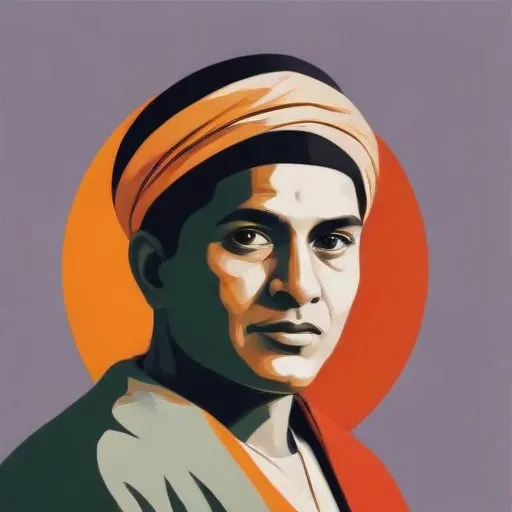
Indian revolutionary who fought for independence from British rule, known for his role in the assassination of a British police officer in 1928.
Shivaram Rajguru is remembered as a brave and dedicated Indian independence activist who played a significant role in the struggle against British colonial rule. He is best known for his involvement in the assassination of British police officer John Saunders, along with his associates Bhagat Singh and Sukhdev Thapar, which ultimately led to their execution by the British government.
Rajguru was born on 24 August 1908 in Khed, a small town located on the banks of the Bheema river near Pune, in a Marathi Deshastha Brahmin family. His father, Harinarayan Rajguru, passed away when Shivaram was just six years old, leaving his elder brother Dinkar to take care of the family.
Rajguru received his primary education in Khed and later attended the New English High School in Pune. He was drawn to the Seva Dal, a social service organization, from a young age, which laid the foundation for his later involvement in revolutionary activities.
Rajguru became an active member of the Hindustan Socialist Republican Association (HSRA), a radical organization that sought Indian independence from British rule by any means necessary. He was involved in the Kakori Conspiracy of 1925, a daring act of robbery on a British train that aimed to fund the HSRA's activities.
Rajguru's most notable act of defiance was the assassination of John Saunders on 17 December 1928, along with Bhagat Singh and Sukhdev Thapar, as a revenge attack for the brutal beating of Lala Lajpat Rai by the police. This event marked a significant milestone in the Indian independence movement.
Rajguru's ancestral home, Rajguru Wada, has been converted into a memorial to honor his legacy. Spread over 2,788 sq m of land, it is located on the banks of the Bheema river on the Pune-Nashik Road. The memorial is a testament to Rajguru's bravery and sacrifice for the Indian independence movement.
Rajguru's execution on 23 March 1931, along with Bhagat Singh and Sukhdev Thapar, has become a symbol of Indian nationalism and resistance against British colonial rule. His selfless act has inspired generations of Indians to fight for their country's freedom and dignity.
Rajguru's life was a testament to his unwavering commitment to the Indian independence movement. His courage and sacrifice continue to inspire Indians to this day, and his legacy remains an integral part of India's struggle for freedom.
Born in 1869
Indian freedom fighter, activist, and philosopher who led India to independence from British rule through non-violent civil disobedience, inspiring civil rights movements worldwide.
Born in 1889
India's first Prime Minister, a key figure in the country's struggle for independence from British rule, and a champion of democracy and secularism. He played a crucial role in shaping modern India's government and economy.
Born in 1897
Indian freedom fighter and politician who led the Indian National Army against British rule and was a key figure in the country's struggle for independence. He is also known for his mysterious disappearance in 1945.
Born in 1907
An Indian socialist revolutionary who fought for independence from British rule through dramatic acts of defiance, including a bombing of the Indian Assembly and a hunger strike that led to his execution.
Born in 1884
India's first president, a key figure in the country's struggle for independence, who played a crucial role in shaping the nation's early years. He's revered for his leadership and commitment to democracy.
Born in 1904
The second Prime Minister of India, leading the country through a tumultuous period, including a war with Pakistan, and known for his simplicity, honesty, and dedication to the nation. He is also credited with promoting the Green Revolution, which transformed India's agricultural sector.
Born in 1917
The first female Prime Minister of India, serving from 1966 to 1977 and again from 1980 until her assassination in 1984, known for her strong leadership and economic reforms.
82 Years Old
The 6th Prime Minister of India, a key figure in Indian politics, known for introducing economic reforms and promoting technology in the country. He was also a strong advocate for social justice and equality.
