


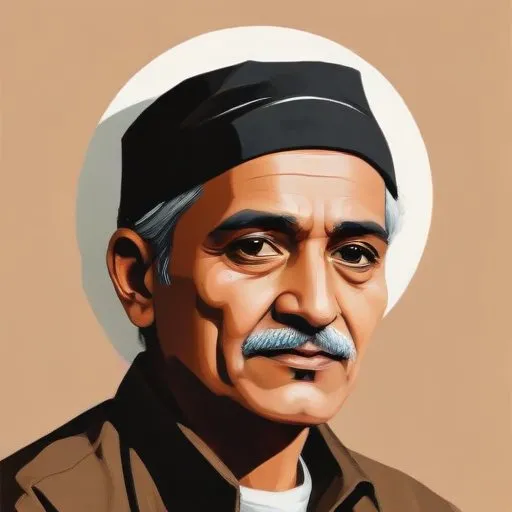
Indian revolutionary and freedom fighter who fought against British colonial rule, known for his involvement in the Lahore Conspiracy Case and his execution at a young age.
Sukhdev Thapar, a name that evokes the spirit of Indian Independence, was a revolutionary freedom fighter who fought against the British government for the freedom of India. He was a key member of the Hindustan Socialist Republican Association (HSRA) and is best known for his role in the assassination of Assistant Superintendent of Police J. P. Saunders, a retaliation for the brutal death of Indian leader Lala Lajpat Rai.
Sukhdev Thapar was born on May 15, 1907, in Ludhiana, Punjab, British Raj, to Ramlal Thapar and Ralli Devi. He belonged to a Punjabi Khatri family of the Hindu community. After the death of his father, Sukhdev was brought up by his uncle Lala Achintram.
Sukhdev Thapar was a prominent figure in the Indian freedom struggle. He was the chief of the Punjab unit of the HSRA and instrumental in making key decisions for the organization. He was a member of the Naujawan Bharat Sabha, a revolutionary organization that aimed to overthrow British rule in India.
Sukhdev took part in several revolutionary events, including a prison hunger strike in 1929. His most notable act of defiance was the assassination of Assistant Superintendent of Police J. P. Saunders, carried out in collaboration with Bhagat Singh and Shivaram Rajguru on December 17, 1928. This act was a retaliation for the brutal death of Lala Lajpat Rai, a senior leader of the Indian freedom movement.
Sukhdev was the main suspect in the 1929 Lahore Conspiracy Case, officially titled Crown versus Sukhdev and others. The case's first information report (FIR), submitted in April 1929, listed Sukhdev as accused number one, describing him as "Swami alias peasant, son of Ram Lal, Thapar Khatri caste."
Sukhdev and his companions, including Bhagat Singh and Shivaram Rajguru, were detained, found guilty, and given a death sentence following the bombings of the Central Assembly Hall in New Delhi on April 8, 1929.
Sukhdev Thapar's sacrifice did not go in vain. His bravery and selflessness inspired a generation of Indians to fight for their freedom. He, along with Bhagat Singh and Shivaram Rajguru, became a symbol of Indian resistance against British rule.
Sukhdev's legacy extends beyond his role in the Indian freedom struggle. He is remembered as a hero who fought for the rights of the oppressed and gave his life for the cause of Indian independence.
Sukhdev Thapar's struggle for Indian independence was part of a larger movement that aimed to overthrow British rule in India. His bravery and sacrifice, along with that of Bhagat Singh and Shivaram Rajguru, paved the way for India's eventual independence in 1947.
Born in 1907
An Indian socialist revolutionary who fought for independence from British rule through dramatic acts of defiance, including a bombing of the Indian Assembly and a hunger strike that led to his execution.
Born in 1897
Founded the Hindustan Republican Association, a revolutionary organization that fought for Indian independence from British rule through armed struggle and propaganda. Known for his bravery and sacrifice in the freedom movement.
Born in 1900
Indian revolutionary who fought against British colonial rule, known for his role in the Kakori conspiracy, a daring train robbery to fund India's freedom struggle.
Born in 1908
Indian revolutionary who fought for independence from British rule, known for his role in the assassination of a British police officer in 1928.
