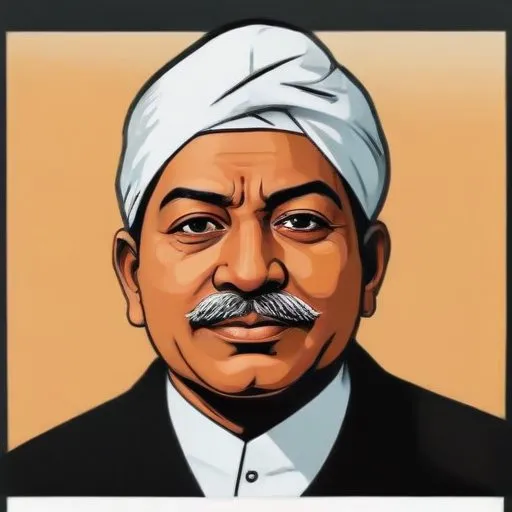
Lala Lajpat Rai: The Punjab Kesari
A Revolutionary Leader and Patriot
Lala Lajpat Rai, popularly known as the "Punjab Kesari," was a Indian revolutionary, politician, and author who played a pivotal role in India's struggle for independence from British rule. He was one of the three members of the Lal Bal Pal trio, along with Lala Bal Pal and
Bipin Chandra Pal, who were instrumental in shaping India's freedom movement.
Early Life and Education
Born on January 28, 1865, in the Punjab Province of British India, Lajpat Rai was the eldest son of Munshi Radha Krishna, an Urdu and Persian government school teacher, and Gulab Devi Aggarwal. He spent much of his youth in Jagraon, where his house still stands today, housing a library and museum. He also founded the first educational institute, R.K. High school, in Jagraon. Rai had his initial education in Government Higher Secondary School, Rewari, Punjab province, and later joined Government College at Lahore to study law.
Influenced by the Hindu Reformist Movement
During his time at Lahore, Rai came into contact with patriots and future freedom fighters, such as Lala Hans Raj and Pandit
Guru Dutt. He was deeply influenced by the Hindu reformist movement of Swami Dayanand Saraswati and became a member of the existing Arya Samaj Lahore, founded in 1877. He also became the founder-editor of the Lahore-based Arya Gazette.
Career and Contributions
Rai's career was marked by his passion for law, education, and politics. In 1884, his father was transferred to Rohtak, and Rai came along after completing his studies at Lahore. In 1886, he moved to Hisar, where his father was transferred, and started practicing law. He became a founding member of the Bar Council of Hisar along with Babu Churamani. Rai also helped Mahatma Hansraj establish the nationalistic Dayananda Anglo-Vedic School, Lahore, and founded the Hisar district branches of the Indian National Congress.
The Sikh Reforms and the Hindu-Muslim Unity
Rai was a strong advocate for Sikh reforms and worked towards promoting Hindu-Muslim unity. He believed that the unity of Hindus and Muslims was essential for India's struggle for independence. He was critical of the British policies that aimed to divide the two communities, and he worked tirelessly to promote communal harmony.
The Simon Commission and the Fatal Protest
In 1928, Rai led a peaceful protest march against the British Simon Commission, which was established to reform India's constitution. The protest turned violent when the police charged the protesters with batons, causing severe head injuries to Rai. He died 18 days later, on November 17, 1928, becoming a martyr for the Indian freedom movement.
Philosophical Contributions and Beliefs
Rai was a strong believer in the importance of education and self-reliance. He advocated for the development of Indian industries and the promotion of swadeshi goods. He also believed in the power of non-violent resistance and was influenced by the ideas of Mahatma Gandhi.
Influence on Modern Society
Rai's contributions to India's freedom movement have had a lasting impact on modern society. He inspired a generation of Indians to fight for their independence and worked towards promoting communal harmony. His legacy continues to inspire Indians today, and he is remembered as a hero of the Indian freedom movement.
Quotes and Memorable Sayings
- "Swadeshi is not just a word, it is a mantra of independence."
- "Education is the key to unlock the chains of slavery."
- "Unity is strength, and our ultimate objective is independence."
Legacy and Historical Context
Rai's sacrifice and contributions to India's freedom movement have earned him a place in the annals of Indian history. He is remembered as a true patriot and a champion of Indian independence. His legacy continues to inspire future generations, and his contributions will always be remembered as a significant milestone in India's struggle for freedom.
FAQ
What was Lala Lajpat Rais role in the Indian independence movement?
Lala Lajpat Rai was a prominent leader in the Indian independence movement, playing a key role in the freedom struggle against British rule in India. He was a vocal critic of British rule and advocated for swaraj, or self-rule, through non-violent protests and civil disobedience.
What were Lala Lajpat Rais contributions to Indian literature?
Lala Lajpat Rai was a prolific writer and contributed significantly to Indian literature. He wrote several books on Indian history, culture, and politics, and was a strong advocate for the promotion of Hindi language and literature.
How did Lala Lajpat Rai die?
Lala Lajpat Rai died on November 17, 1928, due to injuries sustained during a lathi charge by the British police in Lahore.
What was Lala Lajpat Rais stance on Hindu-Muslim unity?
Lala Lajpat Rai believed in Hindu-Muslim unity and worked towards promoting communal harmony. He was a strong critic of communalism and advocated for a united India, where all communities could coexist peacefully.
What is Lala Lajpat Rais legacy in modern India?
Lala Lajpat Rais legacy in modern India is that of a freedom fighter and a champion of Indian culture and literature. He is revered as a national hero and his birthday, January 28, is celebrated as Martyrs Day in India.