


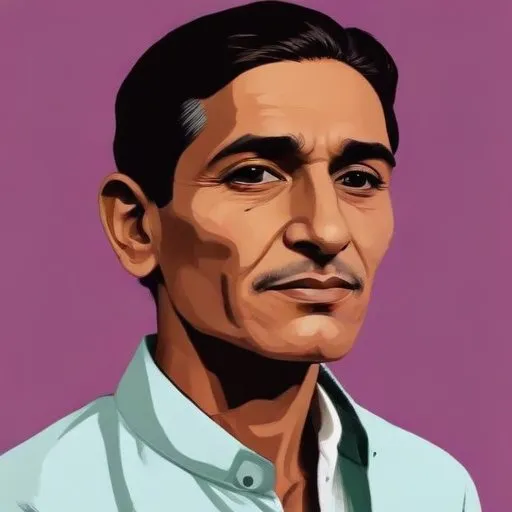
Indian revolutionary who fought against British colonial rule, known for his role in the Kakori conspiracy, a daring train robbery to fund India's freedom struggle.
Ashfaqulla Khan was a prominent figure in the Indian independence movement, known for his bravery and unwavering commitment to freeing India from British rule. As the co-founder of the Hindustan Republican Association, later renamed the Hindustan Socialist Republican Association, Khan played a pivotal role in the fight for independence, earning him a revered place in Indian history.
Born on October 22, 1900, in the Shahjahanpur district of the United Provinces, Khan was the youngest of five siblings to Shafiq Ullah Khan and Mazharunissa. His parents belonged to the Dilzak Pathans of the tribe from Khyber, a landlord caste.
Khan's introduction to revolutionary activities began in 1918, while he was still in school. A police raid on his school, in connection with the Mainpuri Conspiracy, sparked his interest in the independence movement. This event led him to meet Ram Prasad Bismil, a fellow revolutionary and poet, who would become a close friend and mentor.
Khan was deeply inspired by Vladimir Lenin and the Bolshevik Revolution in Russia. He believed in the liberation of the poor and the rejection of capitalist interests. His writings and speeches often emphasized the need to eradicate religious communalism, which he viewed as a tool used by the British to control the Indian population and prevent independence.
In 1925, Khan, along with Bismil and other revolutionaries, planned and executed the famous Kakori train robbery. The heist, which aimed to raise funds for arms and ammunition, was a bold attempt to challenge British authority. Although the robbery was successful, it ultimately led to Khan's capture and subsequent execution in 1927.
Khan was a talented poet, writing Urdu poetry under the pseudonym Hasrat. His literary works often reflected his revolutionary ideals and passion for independence.
Ashfaqulla Khan's bravery and sacrifice have inspired generations of Indians. His contributions to the independence movement played a significant role in shaping India's future. Today, Khan is remembered as a hero and a martyr, his name etched in the annals of Indian history.
Ashfaqulla Khan's legacy extends beyond the Indian independence movement. His ideals of freedom, equality, and social justice continue to inspire people around the world, making him a powerful symbol of resistance against oppression.
Khan's life and sacrifice serve as a reminder of the importance of standing up against injustice and fighting for what is rightfully ours. His story is a testament to the power of courage and conviction, inspiring future generations to continue the struggle for a better tomorrow.
Born in 1897
Founded the Hindustan Republican Association, a revolutionary organization that fought for Indian independence from British rule through armed struggle and propaganda. Known for his bravery and sacrifice in the freedom movement.
Born in 1907
An Indian socialist revolutionary who fought for independence from British rule through dramatic acts of defiance, including a bombing of the Indian Assembly and a hunger strike that led to his execution.
Born in 1907
Indian revolutionary and freedom fighter who fought against British colonial rule, known for his involvement in the Lahore Conspiracy Case and his execution at a young age.
Born in 1908
Indian revolutionary who fought for independence from British rule, known for his role in the assassination of a British police officer in 1928.
Born in 1906
A fearless Indian revolutionary who fought against British colonial rule, known for his bravery and sacrifice in the struggle for independence.
