


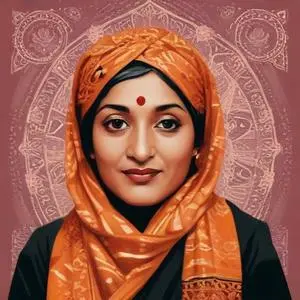
A pioneering Indian poet and activist who used her lyrical voice to advocate for women's rights and Indian independence, leaving a lasting legacy in Indian literature and politics.
Sarojini Naidu was a trailblazing Indian poet, activist, and politician who left an indelible mark on India's struggle for independence. She was the first Indian woman to become the President of the Indian National Congress and the first woman to hold the office of Governor of a state, United Provinces (now Uttar Pradesh), after India gained independence in 1947.
Born on February 13, 1879, in Hyderabad, India, to Bengali Brahmin parents, Sarojini Naidu was the eldest of eight siblings. Her father, Aghorenath Chattopadhyay, was a doctorate of Science from Edinburgh University and the principal of Nizam College. Her mother, Barada Sundari Devi, was a poet in her own right, writing in Bengali.
Sarojini Naidu's exceptional academic prowess was evident from a young age. She passed her matriculation examination at the tender age of 12, earning the highest rank. This achievement paved the way for her to study in England from 1895 to 1898, where she was exposed to the suffragist movement, which would later shape her activism.
Sarojini Naidu's poetic talents were recognized early, with Mahatma Gandhi himself bestowing upon her the nickname "The Nightingale of India." Her poetry, with its vivid imagery and lyrical quality, captured the essence of Indian life and culture. Her most famous poem, "In the Bazaars of Hyderabad," published in 1912, remains a testament to her literary genius.
Drawn to the Indian National Congress party's struggle for independence, Sarojini Naidu became an ardent supporter of Mahatma Gandhi's ideology of swaraj (self-rule). She played a pivotal role in the Indian independence movement, participating in protests, demonstrations, and civil disobedience movements. Her oratory skills and persuasive abilities made her an effective leader, and she was appointed Congress President in 1925.
When India finally gained independence in 1947, Sarojini Naidu was appointed Governor of the United Provinces, a position she held until her passing in 1949. This milestone marked a significant turning point in Indian history, as she became the first woman to hold such a high office.
Sarojini Naidu's life and work have had a profound impact on Indian society. Her poetry and writings have inspired generations of Indians to fight for their rights and strive for freedom. Her legacy continues to inspire women to take on leadership roles, and her contributions to the Indian independence movement remain unparalleled.
"The future belongs to those who believe in the beauty of their dreams." - Sarojini Naidu
Born in 1889
India's first Prime Minister, a key figure in the country's struggle for independence from British rule, and a champion of democracy and secularism. He played a crucial role in shaping modern India's government and economy.
Born in 1861
A Bengali polymath who wrote extensively on love, nature, and humanity, creating a unique blend of Indian and Western literary styles, and was the first non-European to win the Nobel Prize in Literature.
Born in 1917
The first female Prime Minister of India, serving from 1966 to 1977 and again from 1980 until her assassination in 1984, known for her strong leadership and economic reforms.
Born in 1884
India's first president, a key figure in the country's struggle for independence, who played a crucial role in shaping the nation's early years. He's revered for his leadership and commitment to democracy.
Born in 1897
Indian freedom fighter and politician who led the Indian National Army against British rule and was a key figure in the country's struggle for independence. He is also known for his mysterious disappearance in 1945.
Born in 1865
A leading figure in India's struggle for independence from British rule, known for his role in the Indian independence movement and his advocacy for Hindu-Muslim unity.
Born in 1907
An Indian socialist revolutionary who fought for independence from British rule through dramatic acts of defiance, including a bombing of the Indian Assembly and a hunger strike that led to his execution.
