


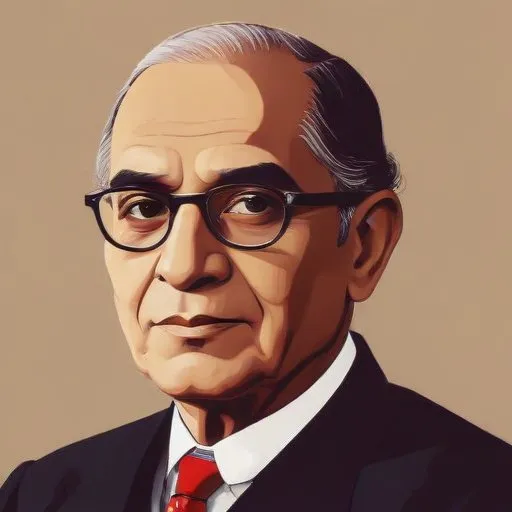
The 5th President of India, a lawyer and politician who played a crucial role in the country's politics during the 1970s, and is remembered for his efforts to maintain national unity and stability.
Fakhruddin Ali Ahmed is remembered as the fifth President of India, serving from 1974 to 1977, and is notable for imposing the Emergency in 1975, which significantly restricted civil liberties and allowed then Prime Minister Indira Gandhi to rule by decree. His legacy is marked by controversy, with some regarding him as a "rubber stamp" president for his support of the Emergency.
Ahmed was born on May 13, 1905, in Delhi to Col. Zalnur Ali, a doctor, and Sahibzadi Ruqaiyya Sultan. His grandfather, Kaliluddin Ali Ahmed, was an Islamic scholar. Ahmed's family was well-educated, and he followed in their footsteps, studying in Delhi and later at Cambridge.
Ahmed was called to the bar from the Inner Temple, London in 1928 and began practicing law in Lahore and later in Guwahati. He became involved with the Indian National Congress in the 1930s and served as finance minister of Assam in the Gopinath Bordoloi ministry in 1939. He went on to hold various positions, including Advocate General of Assam in 1946 and finance minister again from 1957 to 1966 under Bimala Prasad Chaliha.
In 1966, Ahmed was made a national cabinet minister by Prime Minister Indira Gandhi, overseeing various ministries such as Power, Irrigation, Industries, and Agriculture. His experience and loyalty to Gandhi earned him the presidency in 1974, defeating Tridib Chaudhuri in the election.
Ahmed's presidency was marked by the imposition of the Emergency in August 1975, which suspended civil liberties and allowed Gandhi to rule by decree. Ahmed publicly supported the Emergency, which led to widespread criticism and earned him the reputation of being a "rubber stamp" president.
Despite the controversy surrounding his presidency, Ahmed was accorded a state funeral after his death on February 11, 1977, and was buried in a masjid near Parliament House in New Delhi.
Ahmed's presidency is often compared to that of his predecessor, V.V. Giri, who was known for his independence and assertiveness. Ahmed's support of the Emergency and his perceived lack of autonomy have led many to view him as a weaker president in comparison.
Ahmed's commitment to the Indian National Congress and his support of Indira Gandhi's policies reflect his belief in a strong central government and the importance of national unity. However, his support of the Emergency has led some to question his commitment to democratic principles and individual liberties.
Born in 1917
The first female Prime Minister of India, serving from 1966 to 1977 and again from 1980 until her assassination in 1984, known for her strong leadership and economic reforms.
Born in 1889
India's first Prime Minister, a key figure in the country's struggle for independence from British rule, and a champion of democracy and secularism. He played a crucial role in shaping modern India's government and economy.
Born in 1897
The 3rd President of India, a scholar and statesman, played a crucial role in shaping the country's education system and promoting secular values. He was a strong advocate for social justice and equality.
Born in 1888
An Indian philosopher and politician who served as the 2nd President of India, known for his influential writings on Indian philosophy and his role in shaping India's education system.
Born in 1884
India's first president, a key figure in the country's struggle for independence, who played a crucial role in shaping the nation's early years. He's revered for his leadership and commitment to democracy.
Born in 1896
Fourth Prime Minister of India, known for his efforts to decentralize power and promote economic development, and for being the first Indian Prime Minister to resign from office.
Born in 1898
Indian politician who served as the Acting Prime Minister of India twice, known for his leadership during critical periods of Indian history.
Born in 1904
The second Prime Minister of India, leading the country through a tumultuous period, including a war with Pakistan, and known for his simplicity, honesty, and dedication to the nation. He is also credited with promoting the Green Revolution, which transformed India's agricultural sector.
