


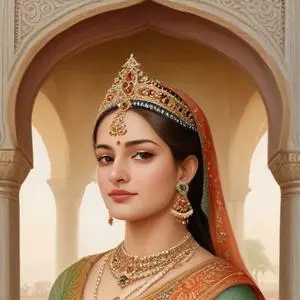
The beloved wife of Mughal Emperor Shah Jahan, buried in the stunning white marble mausoleum she inspired, a testament to eternal love and architectural innovation.
Born in 1592
The fifth Mughal emperor, who built the iconic Taj Mahal as a mausoleum for his beloved wife, and expanded the empire through military campaigns and architectural achievements.
Born in 1614
Mughal Empire's eldest daughter, a poet, and a patron of the arts, known for her literary works and architectural contributions, including the design of Chandni Chowk in Delhi.
Born in 1666
A spiritual leader who founded the Sikh warrior community and wrote poetic compositions that are still revered today, known for his bravery and spiritual guidance.
Born in 1618
The Mughal emperor who ruled India from 1658 to 1707, expanding the empire to its greatest extent and implementing Islamic law, while also being known for his architectural achievements, including the Badshahi Mosque.
Born in 1615
The eldest son of Mughal Emperor Shah Jahan, a philosopher and translator who sought to find common ground between Islam and Hinduism, and translated many Hindu texts into Persian. He was a symbol of religious tolerance and harmony in 17th-century India.
Born in 1643
The seventh Mughal emperor, who ruled India from 1707 to 1712, is known for his military campaigns and efforts to consolidate the empire's territories. He's also famous for his poetry and patronage of the arts.
Born in 1577
The powerful empress who ruled alongside her husband, Jahangir, and was a skilled diplomat, strategist, and patron of the arts, known for her remarkable administrative and military prowess. She was a true partner in power, making key decisions and even leading troops into battle.