


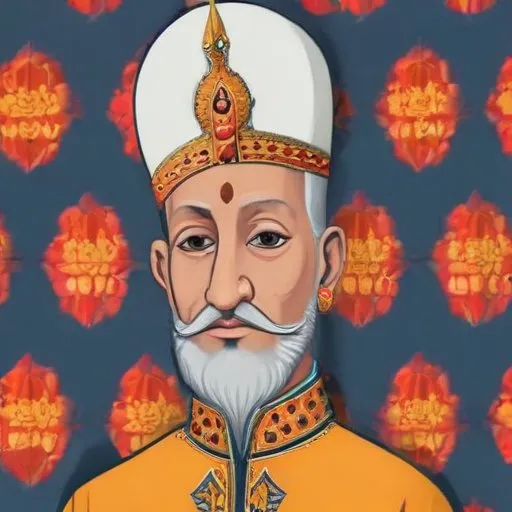
The seventh Mughal emperor, who ruled India from 1707 to 1712, is known for his military campaigns and efforts to consolidate the empire's territories. He's also famous for his poetry and patronage of the arts.
Bahadur Shah I, also known as Shah Alam I, is renowned for being the eighth Mughal Emperor of India, ruling from 1707 to 1712. He is celebrated for his successful overthrow of his brother, Muhammad Azam Shah, and his remarkable efforts to unify the Mughal Empire.
Bahadur Shah I was born as Muhammad Muazzam on October 14, 1643, in Burhanpur, India. He was the second son of the sixth Mughal Emperor, Aurangzeb, and his Pothwari wife, Nawab Bai. During his grandfather, Shah Jahan's reign, Muazzam held various positions, including the vizer of Lahore from 1653 to 1659 and the governor of Deccan in 1663.
After Aurangzeb's death, Bahadur Shah I overthrew his brother, Muhammad Azam Shah, in the Battle of Jajau, one of the largest battles in Indian history. He successfully annexed the Rajput kingdoms of Jodhpur and Amber, which had declared independence prior to his reign. This achievement demonstrated his ability to unify the Mughal Empire and maintain control over its territories.
During his reign, Bahadur Shah I faced several rebellions, including those led by the Sikhs under Banda Bahadur, Rajputs under Durgadas Rathore, and a Mughal prince, Kam Bakhsh. Although he quelled most of these uprisings, his reign was marked by continuous conflicts.
Bahadur Shah I sparked an Islamic controversy by inserting the declaration of Ali as wali in the khutba. This move was seen as a significant departure from traditional Islamic practices. Despite this controversy, his reign is remembered for its attempts to unify the Mughal Empire and maintain its power.
Bahadur Shah I's reign marked the beginning of the decline of the Mughal Empire. His attempts to unify the empire and quell rebellions, although ultimately unsuccessful, demonstrate his efforts to maintain the empire's power and control. His legacy serves as a testament to the complexities and challenges faced by the Mughal Empire during its later years.
Born in 1618
The Mughal emperor who ruled India from 1658 to 1707, expanding the empire to its greatest extent and implementing Islamic law, while also being known for his architectural achievements, including the Badshahi Mosque.
Born in 1592
The fifth Mughal emperor, who built the iconic Taj Mahal as a mausoleum for his beloved wife, and expanded the empire through military campaigns and architectural achievements.
Born in 1702
The last of the great Mughal emperors, who ruled India in the early 18th century, known for his cultural and artistic achievements, particularly in architecture and literature.
