


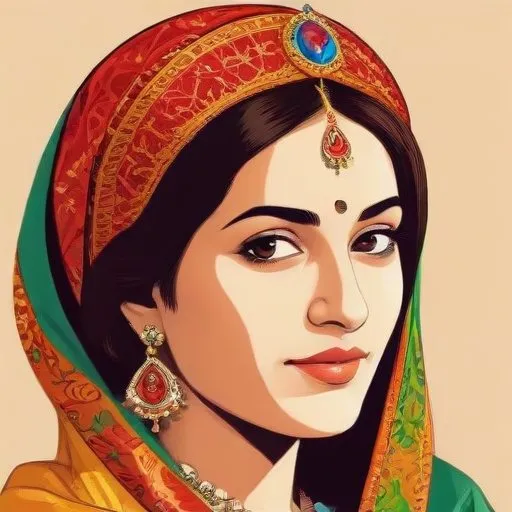
Mughal Empire's eldest daughter, a poet, and a patron of the arts, known for her literary works and architectural contributions, including the design of Chandni Chowk in Delhi.
Jahanara Begum, born on March 23, 1614, was a princess of the Mughal Empire, known for her unparalleled influence and power during her father's reign. As the eldest surviving child of Mughal Emperor Shah Jahan and Mumtaz Mahal, she was entrusted with the royal seal and conferred the title of Padshah Begum, making her the First Lady of the Mughal Empire.
Jahanara's early education was entrusted to Sati al-Nisa Khanam, the sister of Jahangir's poet laureate, Talib Amuli. Sati al-Nisa was known for her knowledge of the Quran, Persian literature, etiquette, housekeeping, and medicine. Jahanara's education included reading, writing poetry, and painting, as well as playing chess, polo, and hunting outdoors. She also had access to the late Emperor Akbar's library, which housed books on world religions, Persian, Turkish, and Indian literature.
After Mumtaz Mahal's untimely death in 1631, Jahanara, at the age of 17, was entrusted with the royal seal and became her father's closest advisor. She wielded significant political influence during Shah Jahan's reign and was described as the most powerful woman in the empire. Her father's favorite daughter, Jahanara was an ardent partisan of her brother, Dara Shikoh, and supported him as her father's chosen successor.
During the war of succession that took place after Shah Jahan's illness in 1657, Jahanara sided with her brother Dara and joined her father in Agra Fort, where he had been placed under house arrest by Aurangzeb. A devoted daughter, she took care of Shah Jahan until his death in 1666. Later, Jahanara reconciled with Aurangzeb, who gave her the title Empress of Princesses and replaced her younger sister, Princess Roshanara Begum, as the First Lady.
Jahanara wrote Munis al-arwah, a biography of Shaikh Muinuddin Chisti, showcasing her literary skills and deep understanding of Sufism.
Jahanara Begum's influence on the Mughal Empire was undeniable. As a powerful woman in a patriarchal society, she broke convention and paved the way for future generations of women. Her reconciliation with Aurangzeb and subsequent rise to the title of Empress of Princesses demonstrated her ability to adapt and thrive in a changing political landscape. Despite the challenges she faced, Jahanara remained devoted to her family and her empire, leaving behind a lasting legacy in the annals of Mughal history.
Jahanara Begum's remarkable life serves as a testament to the power and influence of women in the Mughal Empire. Her story continues to inspire and captivate audiences, offering a fascinating glimpse into the intricate web of politics, family, and loyalty that defined her remarkable life.
Born in 1592
The fifth Mughal emperor, who built the iconic Taj Mahal as a mausoleum for his beloved wife, and expanded the empire through military campaigns and architectural achievements.
Born in 1593
The beloved wife of Mughal Emperor Shah Jahan, buried in the stunning white marble mausoleum she inspired, a testament to eternal love and architectural innovation.
Born in 1618
The Mughal emperor who ruled India from 1658 to 1707, expanding the empire to its greatest extent and implementing Islamic law, while also being known for his architectural achievements, including the Badshahi Mosque.
Born in 1615
The eldest son of Mughal Emperor Shah Jahan, a philosopher and translator who sought to find common ground between Islam and Hinduism, and translated many Hindu texts into Persian. He was a symbol of religious tolerance and harmony in 17th-century India.
