


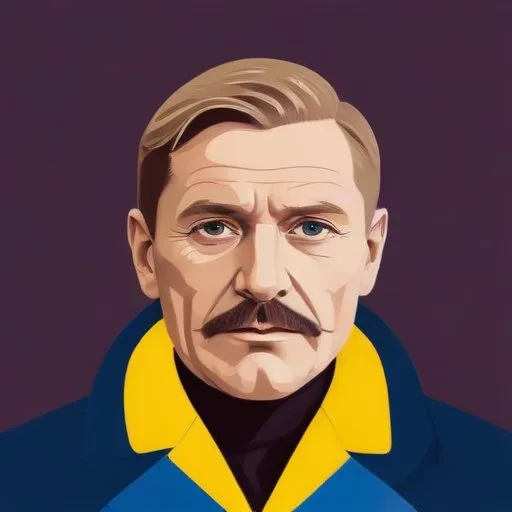
Finnish-Swedish geologist and explorer who led the first expedition to navigate the Northeast Passage and discovered several islands in the Arctic Ocean. He's also known for his geological research in Scandinavia and Russia.
Adolf Erik Nordenskiöld, a Finnish-Swedish aristocrat, geologist, and mineralogist, is renowned for being the first to successfully navigate the Northeast Passage, a feat that ranks among the highest achievements in Swedish scientific history. Born on November 18, 1832, in Helsinki, Finland, Nordenskiöld's groundbreaking expedition, known as the Vega Expedition, took place from 1878 to 1879, and marked a significant milestone in the history of Arctic exploration.
Nordenskiöld was born into a family of scientists and nobility. His father, Nils Gustaf Nordenskiöld, was a Finnish mineralogist, civil servant, and traveler, who was also a member of the Russian Academy of Sciences. Nordenskiöld spent his early years on the family estate, Alikartano Manor, in Mäntsälä, Finland, before attending school in Porvoo. He later enrolled in the Imperial Alexander University in Helsinki in 1849, where he developed his passion for geology and mineralogy.
In 1878, Nordenskiöld embarked on the Vega Expedition, a daring endeavor to navigate the Northeast Passage, a treacherous and previously uncharted route along the northern coast of Eurasia. The expedition was not without its challenges, facing severe weather conditions, icebergs, and mutinies among the crew. However, under Nordenskiöld's leadership, the expedition successfully completed the passage, opening up new trade routes and opportunities for scientific discovery.
Nordenskiöld's achievement had far-reaching consequences, not only for the field of Arctic exploration but also for Sweden's scientific reputation. He was hailed as a national hero, and his expedition sparked a new era of scientific inquiry and exploration. His legacy extends beyond his own achievements, with his family members also making significant contributions to the fields of geology, ethnography, and exploration.
Nordenskiöld was a member of the Swedish Academy and the Parliament of Sweden. He was also a devoted father to his sons, Gustaf and Erland, who followed in his footsteps as explorers. Through his sister, Anna Elisabet Sofia, he was the maternal uncle of Nils Otto Gustaf Nordenskjöld, another renowned polar explorer.
Nordenskiöld received numerous awards and honors for his outstanding contributions to science and exploration. He was awarded the Copley Medal in 1883 by the Royal Society, and was also conferred upon the title of friherre (baron) in recognition of his achievements.
In conclusion, Adolf Erik Nordenskiöld's pioneering spirit, scientific expertise, and perseverance have left an indelible mark on the history of Arctic exploration. His legacy continues to inspire generations of scientists, explorers, and adventurers, and his remarkable achievements remain a testament to the power of human ingenuity and determination.
Born in 1833
A renowned geographer and academic who pioneered the field of geomorphology, mapping and describing the Earth's landforms and landscapes. He's credited with coining the term "Silk Road" to describe the ancient trade routes between Europe and Asia.
Born in 1865
A Swedish geographer and explorer who mapped previously unknown areas of Central Asia, including the Silk Road, and discovered the Transhimalaya mountain range.
Born in 1769
A pioneering geographer and explorer who mapped much of South America and discovered the Caspian Sea's connection to the Black Sea, greatly advancing our understanding of the natural world.
Born in 1779
Founded the modern academic field of geography, emphasizing the importance of human-environment interactions and cultural differences in shaping the world around us.
Born in 1880
A German meteorologist and geophysicist who proposed the theory of continental drift, suggesting that the Earth's continents were once joined together in a single supercontinent. This revolutionary idea transformed our understanding of the Earth's history and plate tectonics.
