


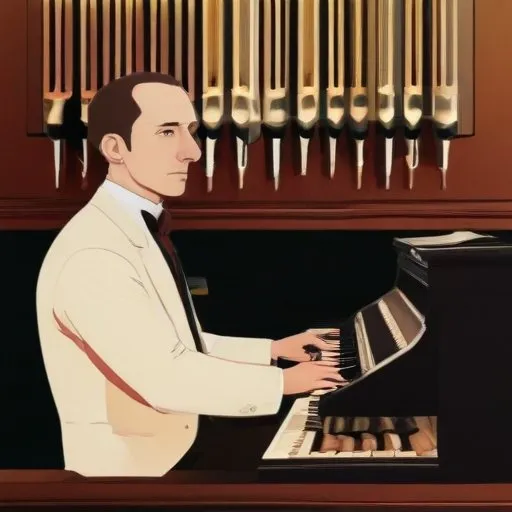
A renowned Baroque-era organist and composer, known for his innovative and influential contributions to the development of the concerto grosso and oratorio genres.
Adriano Banchieri, an Italian composer, music theorist, organist, and poet, left an indelible mark on the world of music, particularly in the late Renaissance and early Baroque eras. He is renowned for developing the madrigal comedy, a unique form of unstaged yet dramatic collections of madrigals that told a story when sung consecutively.
Born on September 3, 1568, in Bologna, Italy, Banchieri was initially named Tommaso but later changed it to Adriano when he took his vows as a Benedictine monk in 1590. During his monastic training, he was influenced by his teacher Gioseffo Guami, who shaped his compositional style.
Banchieri's passion for madrigal comedies led him to create a series of dramatic collections, including his famous work, La pazzia senile, published in 1598. This innovative form of musicodramatic expression paved the way for opera, although music scholars now recognize it as a distinct development. Banchieri's madrigal comedies featured complex plots and character development, showcasing his mastery of the genre.
In addition to his groundbreaking work in madrigal comedies, Banchieri was a prolific composer of canzonettas, a lighter and highly popular alternative to madrigals in the late 16th century. He also published several editions of organ works, including L'organo suonarino, starting from 1605.
Banchieri was vocal about his disapproval of the monodists and their harmonic innovations, which he expressed in his treatise, Moderna Pratica Musicale, published in 1613. In this work, he systematized the legitimate use of figured bass, a technique that allowed for greater musical expression.
Banchieri's contributions to music have had a lasting impact on the development of opera and musicodramatic forms. His madrigal comedies have inspired generations of composers, including Claudio Monteverdi, who would later become a prominent figure in the evolution of opera.
Banchieri's life was marked by his dedication to music and his monastic vows. He spent most of his life in Bologna, where he was born and died in 1634.
Through his innovative compositions and theoretical works, Adriano Banchieri left an indelible mark on the world of music, shaping the course of opera and musicodramatic forms for generations to come.
Born in 1567
A Baroque music pioneer who revolutionized the opera and sacred music genres with innovative harmonies and orchestration, leaving an indelible mark on classical music.
Born in 1585
A renowned Baroque composer and organist, known for his contributions to the development of the oratorio and passion genres, creating over 500 works that showcased his mastery of choral music.
