


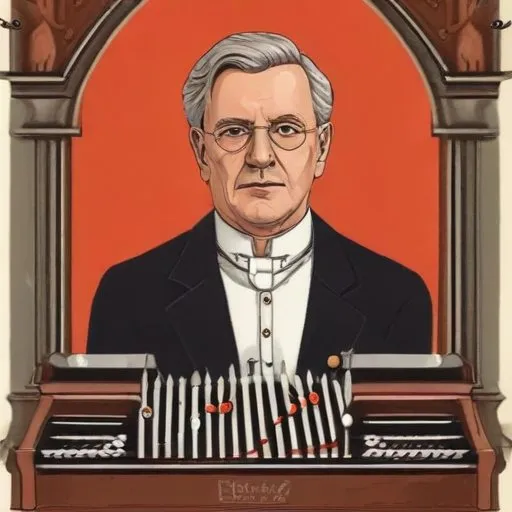
A renowned Baroque composer and organist, known for his contributions to the development of the oratorio and passion genres, creating over 500 works that showcased his mastery of choral music.
Regarded as one of the most important composers of the 17th century, Heinrich Schtz is credited with bringing the Italian style to Germany and continuing its evolution from the Renaissance into the early Baroque. With a remarkable output of over 500 surviving works, Schtz is undoubtedly the most important German composer before Johann Sebastian Bach.
Born on October 8, 1585, in Kstritz, Schtz was the eldest son of Christoph Schtz and Euphrosyne Bieger. His family moved to Weienfels when he was five, where his father managed an inn, and later served as burgomaster. It was during this time that Schtz's musical talents were discovered by Landgrave Moritz von Hessen-Kassel in 1598, leading to his further education and instruction at the noble court in Kassel.
Schtz's music was primarily written for the Lutheran church, with most of his compositions intended for the Electoral Chapel in Dresden. Although his ceremonial and theatrical scores have been lost, his surviving works showcase his mastery of the Italian style, which he adapted to German tastes.
Schtz is famously credited with writing the first German opera, Dafne, which premiered in Torgau in 1627. Unfortunately, the music has been lost, leaving only the libretto behind.
Schtz's significance extends beyond his own compositions. He played a crucial role in shaping the German Baroque style, influencing a generation of composers, including Johann Sebastian Bach. His legacy is commemorated in some North American Lutheran churches, where he is celebrated as a musician on July 28, along with Bach and Handel.
In addition to his impact on music, Schtz's legacy can be seen in his contributions to the development of the German opera, as well as his role in popularizing the use of instruments in church music.
While there are no direct quotes from Schtz, his music and compositions speak to his commitment to his craft, as well as his innovative spirit.
Schtz's life and work spanned a tumultuous period in German history, marked by the Thirty Years' War and the rise of the Lutheran Church. His music not only reflected the cultural and religious landscape of his time but also helped shape it.
In the centuries following his death, Schtz's music fell into relative obscurity, only to be rediscovered in the 19th and 20th centuries. Today, he is recognized as a pioneering figure in German Baroque music, whose influence can be seen in the works of Bach, Handel, and beyond.
Born in 1685
A master of Baroque music, he composed over 1,000 works, including orchestral suites, cantatas, and passions, that still inspire and influence musicians today. His innovative use of counterpoint and harmony raised the bar for classical music.
Born in 1685
A renowned Baroque composer and organist, famous for creating majestic orchestral suites, operas, and oratorios, including the iconic "Messiah" masterpiece.
Born in 1567
A Baroque music pioneer who revolutionized the opera and sacred music genres with innovative harmonies and orchestration, leaving an indelible mark on classical music.
Born in 1644
A virtuosic violinist and composer, he wrote innovative and technically demanding works that showcased his mastery of the instrument, influencing the development of the violin concerto. His music is still performed and admired today.
Born in 1678
A virtuosic violinist and prolific composer, he crafted over 400 concertos, including "The Four Seasons," which remains a beloved and iconic masterpiece of classical music.
Born in 1653
A virtuosic violinist and composer who revolutionized the concerto grosso form, creating a new era of classical music. His influential works elevated the violin to a solo instrument, shaping the course of Western classical music.
Born in 1659
A renowned Baroque composer, known for his iconic opera "Dido and Aeneas" and contributions to English classical music.
