


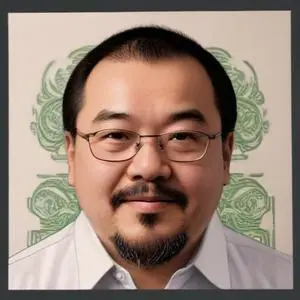
A Chinese sculptor and activist who uses art to critique government policies and advocate for human rights, creating large-scale installations and provocative works that spark global conversations.
Ai Weiwei, the son of renowned Chinese poet Ai Qing, is a world-renowned artist, documentarian, and activist who has challenged the status quo in China, defying political and artistic norms. Known for his bold installations, thought-provoking documentaries, and relentless pursuit of government transparency, Ai has become a beacon of hope for democracy and human rights in China.
Born on August 28, 1957, in Beijing, China, Ai's early life was marked by hardship and exile. His father, Ai Qing, was denounced during the Anti-Rightist Movement, and the family was sent to a labor camp in Heilongjiang when Ai was just one year old. This tumultuous upbringing would later shape Ai's art and activism, as he drew inspiration from his experiences and the injustices he witnessed.
Ai's artistic career spans over three decades, during which he has experimented with various mediums, from sculpting and photography to architecture and film. His work often incorporates subtle references to Chinese history, politics, and culture, while also exploring universal themes like freedom, identity, and the human condition. Some of his most notable works include:
Ai's activism has not gone unnoticed by the Chinese government. In April 2011, he was arrested at Beijing Capital International Airport and detained for 81 days without charge, sparking international outcry. The incident only fueled Ai's determination to speak truth to power, as he continued to challenge the government's stance on democracy and human rights.
Ai's work has been exhibited globally, with solo shows at the Tate Modern, the Museum of Modern Art (MoMA), and the Guggenheim Museum, among others. He has received numerous awards and honors, including the Václav Havel Prize for Creative Dissent (2012) and the Margit Fischer Prize for Human Rights (2014).
Ai's art and activism are deeply rooted in his philosophical beliefs, which emphasize the importance of individual freedom, government transparency, and human rights. He has stated, "The best way to protect our own rights is to protect the rights of others." His work serves as a testament to the power of art to inspire social change and challenge oppressive regimes.
In 2015, Ai was allowed to leave China and has since lived in Portugal, Germany, and the United Kingdom. He has continued to create provocative work, engaging with global issues like migration, surveillance, and freedom of speech.
Ai Weiwei's contributions to Chinese modernism, activism, and cultural development have cemented his status as a vital instigator and one of the nation's most vocal political commentators. His work will continue to shape the cultural landscape of China and inspire future generations of artists and activists.
"I don't want to be just a good artist, I want to be a good person." — Ai Weiwei
Ai's impact extends beyond the art world, influencing modern society through his activism, documentaries, and public works. He has inspired a new wave of Chinese artists, activists, and citizens to speak out against government oppression and fight for democratic values.
Ai's artistic and activist career has spanned over three decades. Take a glimpse at some of the key milestones and events that have shaped his journey:
Ai Weiwei's unwavering commitment to art, activism, and human rights has made him a global icon, inspiring generations to come. As he continues to create, challenge, and inspire, his legacy will forever be etched in the annals of Chinese history and modern art.
72 Years Old
A renowned artist creating large-scale, thought-provoking sculptures that explore themes of materiality, space, and human experience. His works often feature biomorphic forms, vibrant colors, and interactive elements.
86 Years Old
A pioneering figure in modern sculpture, known for large-scale, site-specific installations that challenge viewers' perceptions of space and materiality.
71 Years Old
A contemporary artist renowned for pushing boundaries with large-scale, hyper-realistic sculptures and installations that explore themes of consumerism, pop culture, and the human experience.
64 Years Old
A contemporary artist blending fine art, pop culture, and anime, creating colorful, playful, and thought-provoking works that explore the intersection of high and low culture.
94 Years Old
A pioneering artist who blurred the lines between photography and painting, creating bold, abstract works that challenged traditional notions of representation. Known for his bold, colorful, and often provocative pieces that explored the relationship between image and reality.
