


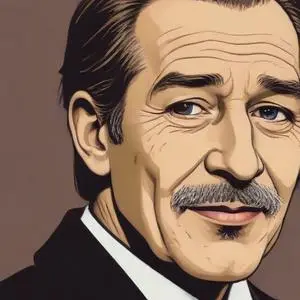
A Czech poet, playwright, and politician who led the country's transition from communism to democracy, and is known for his advocacy of human rights and individual freedom.
Vclav Havel, a Czech statesman, author, poet, and playwright, is renowned for his pivotal role in leading Czechoslovakia and later the Czech Republic through the tumultuous transition from communism to democracy. As the last president of Czechoslovakia and the first president of the Czech Republic, Havel's legacy is inextricably linked to the country's struggle for freedom and self-determination.
Born on October 5, 1936, in Prague, Czechoslovakia, Havel's early life was marked by an innate desire to challenge the status quo. Despite his bourgeois family background, which limited his educational opportunities under the communist regime, Havel pursued his passion for writing. His initial success as a playwright, with works like The Garden Party and The Memorandum, critiqued the communist system through absurdist satire.
In the late 1960s, Havel became increasingly involved in the pro-democracy movement, participating in the Prague Spring and subsequently facing blacklisting and persecution. His activism led to the formation of dissident initiatives, including Charter 77 and the Committee for the Defense of the Unjustly Prosecuted. Havel's unyielding stance against the communist regime resulted in multiple periods of imprisonment, including a four-year term from 1979 to 1983.
Havel's Civic Forum party played a crucial role in the 1989 Velvet Revolution, which toppled the communist government. As the first democratically elected president of Czechoslovakia and later the Czech Republic, Havel oversaw the country's transition to democracy. During his presidency, he implemented significant reforms, including the dissolution of the Warsaw Pact and the expansion of NATO membership eastward.
Havel's presidency was not without controversy. His opposition to Slovak independence and criticism of the post-World War II treatment of Sudeten Germans sparked debate. Additionally, his decision to grant a general amnesty to those imprisoned under communism raised concerns among some Czech citizens.
Havel's personal life was marked by several milestones, including his marriage to Olga Havlová in 1964 and his receipt of the Presidential Medal of Freedom from Bill Clinton in 1998. Some of his memorable quotes include: "The salvation of this human world lies nowhere else than in the human heart, in the human power to reflect, in human meekness and human responsibility" and "The tragedy of modern man is that he doesn't know what he wants, but he wants it anyway."
Vclav Havel's legacy extends far beyond his political achievements. As a writer, he contributed significantly to Czech literature, while his philosophical ideas on human freedom and responsibility continue to inspire. His presidency and activism paved the way for a new era of democracy in the Czech Republic, cementing his place as a champion of human rights and freedom.
Vclav Havel's life was a testament to the power of creative resistance and the human spirit. As a writer, dissident, and statesman, he left an indelible mark on Czech history, inspiring generations to come.
| 1936 | Vclav Havel was born on October 5th |
| 1960s | Havel becomes involved in the pro-democracy movement |
| 1979-1983 | Havel serves a four-year prison sentence |
| 1989 | The Velvet Revolution takes place; Havel becomes president of Czechoslovakia |
| 1993 | Havel becomes the first president of the Czech Republic |
| 2003 | Havel's presidency ends |
| 2011 | Vclav Havel passes away on December 18th |
94 Years Old
A Czech-American actor, director, and screenwriter who brought complex, nuanced stories to life on screen, earning acclaim for his work on films like "One Flew Over the Cuckoo's Nest" and "Amadeus".
Born in 1914
A Czech writer celebrated for his poetic and humorous novels that explore the human condition, often set against the backdrop of World War II and communist Czechoslovakia.
97 Years Old
A Czech-French writer who explored the human condition through novels, poetry, and plays, often blending philosophy and politics with a touch of irony and humor. His works are known for their lyrical style and exploration of themes such as identity, morality, and the search for meaning.
Born in 1921
A Slovak politician who led a brief, failed attempt to reform communism in Czechoslovakia during the Prague Spring of 1968, known for his efforts to introduce democratic reforms.
Born in 1926
A Czech journalist and author who wrote novels and essays that critiqued communism, and is best known for his 1967 novel "The Guinea Pigs" which satirized the Soviet occupation.
