


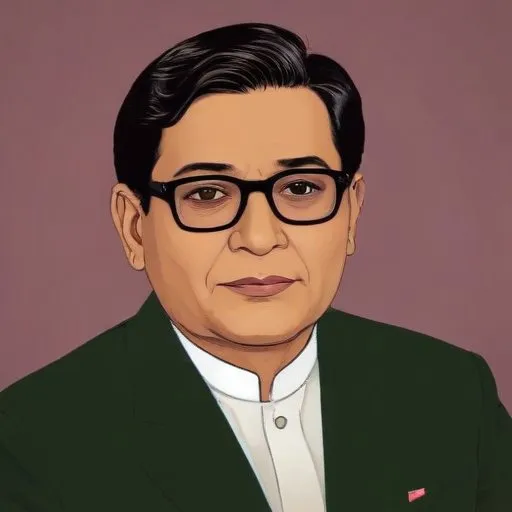
The Chief Minister of West Bengal from 1967 to 1969 and again from 1969 to 1970, known for his efforts to establish a United Front government in the state. He played a key role in shaping the region's politics during a tumultuous period.
Ajoy Mukherjee, a stalwart of Indian independence, is renowned for his unwavering dedication to the country's freedom struggle and his remarkable tenure as the Chief Minister of West Bengal. Born on April 15, 1901, in Tamluk, West Bengal, Mukherjee's life was a testament to his unrelenting spirit and his commitment to the welfare of the people.
Mukherjee's tryst with the Indian independence movement began during the Quit India Movement in 1942, when he played a pivotal role in the formation of the Tamralipta Jatiya Sarkar (Tamrlipta National Government). This movement, which came into effect on December 17, 1942, was a programme of civil disobedience that sought to liberate India from British rule.
Mukherjee's life and ideology were deeply influenced by the teachings of Swami Vivekananda, a renowned Indian philosopher and social reformer. Vivekananda's emphasis on self-reliance, education, and social service had a profound impact on Mukherjee, shaping his worldview and inspiring him to work towards the betterment of society.
Mukherjee's political career began as a member of the Indian National Congress, but he later rose to prominence as a leader in the Bangla Congress. His unwavering commitment to the people and his unshakeable faith in democracy earned him the respect and admiration of his contemporaries.
Mukherjee served as the Chief Minister of West Bengal for two short terms, from March to November 1967, and again from February 1969 to March 1970. During his tenure, he worked tirelessly to address the concerns of the people, particularly in the areas of education, healthcare, and rural development.
In recognition of his remarkable contributions to the nation, Mukherjee was awarded the Padma Vibhushan in 1977, one of India's highest civilian honours. This award was a testament to his unwavering dedication to the people and his unrelenting pursuit of social welfare.
Mukherjee's personal life was marked by simplicity, humility, and a deep sense of compassion. He remained humble and grounded, even in the face of great success and recognition. His legacy continues to inspire generations, serving as a beacon of hope and a reminder of the power of selfless service.
Mukherjee's life and legacy have had a profound impact on modern Indian society. His commitment to democracy, education, and social welfare has inspired countless individuals to work towards creating a more just and equitable society.
Ajoy Mukherjee's story is a testament to the power of human spirit, a reminder that even the most ordinary individuals can achieve extraordinary things with courage, conviction, and a deep sense of purpose.
Born in 1882
A pioneering physician and politician who played a key role in shaping West Bengal's healthcare and education systems, earning him the Bharat Ratna award.
Born in 1914
The 6th Chief Minister of West Bengal, a stalwart of Indian communism, led the state for 23 years, implementing land reforms and promoting industrialization. He was a key figure in Indian politics, known for his pragmatic approach and secular values.
90 Years Old
The 13th President of India, a seasoned politician and journalist, served as the head of state from 2012 to 2017, playing a key role in shaping the country's economy and foreign policy. He's known for his diplomatic skills and ability to build consensus.
Born in 1920
A prominent Indian lawyer and politician who served as the Chief Minister of West Bengal, known for his efforts to modernize and industrialize the state. He played a key role in shaping India's political landscape during the 1970s.
Born in 1897
Indian accountant and politician who served as the 3rd Chief Minister of West Bengal, known for his role in shaping the state's economy and infrastructure development.
