


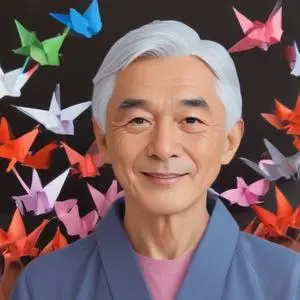
Creator of modern origami, credited with elevating it from a traditional Japanese art form to a modern, global phenomenon through innovative designs and techniques.
Akira Yoshizawa is widely credited with elevating origami from a traditional Japanese craft to a living art form. With a career spanning over six decades, Yoshizawa created more than 50,000 origami models, revolutionizing the way we think about paper folding and geometry.
Born on March 14, 1911, in Kaminokawa, Japan, Yoshizawa grew up in a family of dairy farmers. As a child, he developed a passion for origami, which he taught himself. This early fascination with paper folding laid the foundation for his future innovations.
In his early 20s, Yoshizawa's passion for origami was rekindled when he became a technical draftsman. He used origami to explain complex geometrical concepts to his junior colleagues, sparking a new wave of creativity. In 1937, he left his factory job to pursue origami full-time, despite the financial struggles that ensued.
During World War II, Yoshizawa served in the army medical corps in Hong Kong. He used origami to lift the spirits of sick patients, but eventually fell ill himself and returned to Japan. It was during this period that his work gained recognition, including publication in the 1944 book Origami Shuko by Isao Honda.
In 1952, Yoshizawa's career took off with the publication of his work in the Asahi Graph magazine, featuring his iconic origami zodiac signs. This breakthrough led to the publication of his first monograph, Atarashii Origami Geijutsu (New Origami Art), in 1954.
In his seminal work, Yoshizawa established the Yoshizawa-Randlett system of notation for origami folds, a groundbreaking contribution to the field. This system has since become the standard for origami notation, enabling enthusiasts worldwide to replicate his designs with precision.
In recognition of his contributions to Japanese culture, Emperor Hirohito awarded Yoshizawa the Order of the Rising Sun, 5th class, in 1983. This prestigious honor cemented Yoshizawa's status as a cultural ambassador for Japan.
Akira Yoshizawa's influence on modern origami is immeasurable. He has inspired generations of origami artists, designers, and enthusiasts, and his work continues to influence various fields, from mathematics and engineering to art and design. His legacy serves as a testament to the power of creativity and innovation.
Akira Yoshizawa's remarkable journey, marked by creativity, perseverance, and innovation, continues to inspire and fascinate people around the world. His legacy serves as a testament to the transformative power of art and creativity.
Born in 1828
A captain, lawyer, and politician who served as the 33rd Speaker of the United States House of Representatives, known for his strong leadership during the Reconstruction Era. He played a crucial role in shaping the country's post-Civil War policies.
