


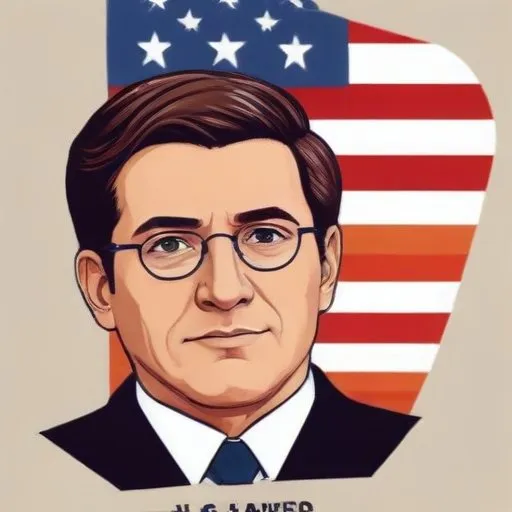
A captain, lawyer, and politician who served as the 33rd Speaker of the United States House of Representatives, known for his strong leadership during the Reconstruction Era. He played a crucial role in shaping the country's post-Civil War policies.
Samuel J. Randall, a prominent figure in American politics, is best known for his unwavering advocacy of protective tariffs, which profoundly shaped the country's economic landscape during the late 19th century. As the 29th Speaker of the United States House of Representatives from 1876 to 1881, Randall played a pivotal role in shaping the nation's fiscal policies, earning him recognition as a stalwart defender of domestic producers of manufactured goods.
Randall's political ideology was characterized by a strong belief in the importance of protective tariffs, which he saw as essential for promoting American industry and protecting domestic producers. This stance often aligned him with Republicans on tariff issues, although he differed from them in his resistance to Reconstruction and the growth of federal power. Randall's commitment to smaller, less centralized government resonated with House Democrats, earning him their respect and admiration.
Randall's advocacy for protective tariffs had a profound impact on the development of American industry, shaping the country's economic trajectory and influencing the course of its trade policies. His legacy continues to be felt in contemporary trade debates, with his ideas on protectionism remaining relevant in modern economic discourse.
Randall's life and career were shaped by the tumultuous period of American history following the Civil War. His commitment to protective tariffs and smaller government reflected the concerns of his era, as the nation grappled with the challenges of Reconstruction and industrialization. Today, Randall's legacy serves as a testament to the enduring importance of economic policy in shaping the course of American history.
Randall's political ideology and policy stances can be compared to those of his contemporaries, including prominent figures such as Grover Cleveland and James G. Blaine. While Randall's commitment to protectionism set him apart from many of his Democratic colleagues, his resistance to federal power aligned him with fellow Democrats who sought to limit the growth of centralized authority.
Randall's influence on American politics and trade policy has had a lasting impact on popular culture, shaping the way Americans think about economic issues and the role of government in shaping the economy. His legacy continues to be felt in the ongoing debates surrounding trade policy and globalization.
Born in 1822
Led the Union Army to victory in the Civil War and later became President, known for issuing the Emancipation Proclamation and strengthening federal authority.
Born in 1822
The 19th President of the United States, a general, lawyer, and politician who ended the Reconstruction era and withdrew federal troops from the South, allowing Racial Segregation to begin. He's also known for being a strong supporter of education and civil service reform.
Born in 1831
The 20th President of the United States was a multifaceted leader who served as a general in the Civil War and later became a lawyer and politician, known for his strong advocacy for education and civil rights. He's also infamous for being assassinated just six months into his presidency.
Born in 1829
The 21st President of the United States, a strong advocate for civil service reform, is most known for signing the Pendleton Civil Service Act, which transformed the federal government's hiring practices. He's also remembered for his unexpected rise to presidency after the assassination of James A. Garfield.
Born in 1837
The first Democrat elected after the Civil War, he served two non-consecutive terms, earning him a unique spot in history, and is often remembered for his strong leadership and commitment to limited government.
Born in 1833
The 23rd President of the United States was a prominent leader who oversaw the admission of six new states to the Union and supported education and conservation efforts. He's also known for being the grandson of William Henry Harrison, the 9th President.
Born in 1843
The 25th President of the United States, a strong leader who championed high tariffs and annexed Hawaii, is most known for being assassinated at the 1901 World's Fair. He played a significant role in shaping the country's economy and foreign policy.
Born in 1858
A pioneering leader who championed progressive reforms, trust-busting, and conservation, earning a Nobel Peace Prize for mediating the Russo-Japanese War. He's also famous for his rugged outdoorsmanship and "big stick" diplomacy.
