


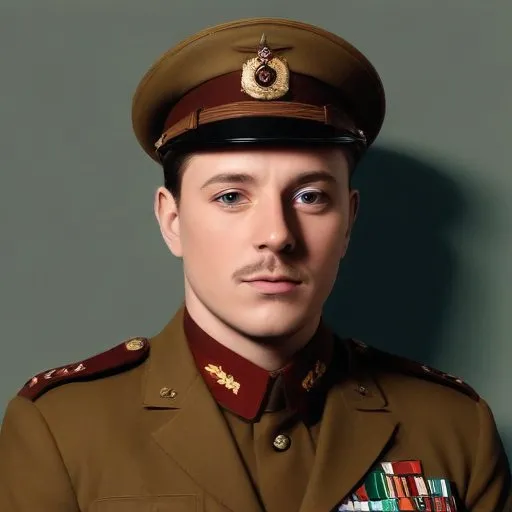
A Canadian lieutenant who received the Victoria Cross for his bravery during World War I, particularly for his actions during a dogfight where he shot down several enemy planes while severely injured. He is celebrated for his selfless heroism and aerial combat skills.
Alan Arnett McLeod is renowned for being one of the youngest recipients of the Victoria Cross, the highest award for gallantry in the face of the enemy that can be awarded to British and Commonwealth forces. At just 18 years old, McLeod's bravery in the skies during World War I earned him this prestigious honor.
McLeod was born on April 20, 1899, in Stonewall, Manitoba, Canada, to a doctor's family. He enlisted in The 34th Fort Garry Horse at the age of 14 in 1913. However, when World War I broke out in 1914, McLeod was sent home due to being underage.
Determined to serve, McLeod tried several times to enlist in the army in Winnipeg and the Royal Flying Corps (RFC) in Toronto. Finally, on his 18th birthday, he successfully enrolled in the RFC and began his aviation journey.
McLeod trained as a pilot at Long Branch near Toronto, soloing after just three hours of flight time. He graduated with 50 hours of flying experience and was shipped overseas to France on August 20, 1917.
Initially posted to No. 82 Squadron RFC, McLeod was later transferred to No. 51 Squadron RFC for Home Defence duties, flying at night due to his young age. He eventually joined No. 2 Squadron RFC, a Corps Squadron, where he flew his first operation in December 1917.
On March 27, 1918, over Albert, France, McLeod, with his observer Lieutenant Arthur Hammond, in an Armstrong Whitworth F.K.8, destroyed an enemy triplane and were immediately attacked by eight more, three of which they brought down. This heroic feat earned him the Victoria Cross.
McLeod's bravery and selflessness during World War I inspired a generation of pilots and soldiers. His Victoria Cross award further solidified the importance of aerial combat in modern warfare.
Alan Arnett McLeod's legacy extends beyond his military service. He is remembered as a hero, a symbol of courage, and an inspiration to those who have followed in his footsteps.
McLeod's story serves as a testament to the sacrifices made during World War I, and his bravery will continue to inspire generations to come.
Born in 1872
A Canadian physician, soldier, and poet who wrote the iconic poem "In Flanders Fields," which became a symbol of World War I and is still widely recited today.
Born in 1920
A decorated Marine who fought in World War II, writing about his experiences in bestselling books like "Helmet for My Pillow" and inspiring the HBO miniseries "The Pacific".
