


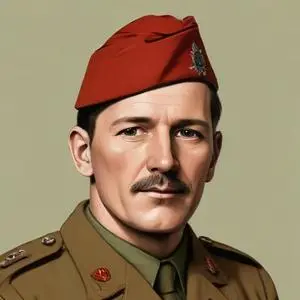
A Canadian physician, soldier, and poet who wrote the iconic poem "In Flanders Fields," which became a symbol of World War I and is still widely recited today.
John McCrae, a Canadian poet, physician, author, artist, and soldier, is best known for writing the iconic war memorial poem "In Flanders Fields," a poignant tribute to the fallen soldiers of World War I.
McCrae's multifaceted life was marked by a strong sense of duty, creativity, and compassion. Born on November 30, 1872, in Guelph, Ontario, Canada, he was the grandson of Scottish immigrants. His father, Lieutenant Colonel David McCrae, had served with the Guelph Home Guard during the Fenian raids, and was a member of the Guelph city council and a director of The North American Life Assurance Company.
McCrae attended the Guelph Collegiate Vocational Institute and graduated from the Institute at 16. He was the first Guelph student to win a scholarship to the University of Toronto, where he was a member of the Theta Xi chapter of the Zeta Psi International Fraternity. Despite struggling with severe asthma, which would recur throughout his life, McCrae persevered and went on to study medicine.
McCrae's experience as a surgeon during the Second Battle of Ypres in Belgium had a profound impact on him. The devastation and loss of life he witnessed inspired him to write "In Flanders Fields," a poem that would become a powerful symbol of remembrance and sacrifice. The poem's famous lines, "In Flanders fields the poppies blow / Between the crosses, row on row," evoke the haunting beauty of a ravaged landscape and the ultimate sacrifice of those who fought and died.
McCrae's personal life was marked by close relationships with his family and friends. His sister Geills married James Kilgour, a justice of the Court of Kings Bench of Manitoba, and moved to Winnipeg. He also maintained a close friendship with Laura Kains, to whom he wrote a letter in 1893, describing his life as an artilleryman.
McCrae died of pneumonia on January 28, 1918, near the end of World War I. His poem, "In Flanders Fields," has become an enduring symbol of remembrance and sacrifice, ensuring that his legacy continues to inspire generations to come.
Born in 1865
A renowned author and poet, best known for his imaginative and vivid stories, particularly "The Jungle Book", which have captivated readers of all ages with their timeless themes and memorable characters.
Born in 1871
Prolific writer of historical novels and adventure stories, also a talented landscape painter.
Born in 1872
A Canadian physician, soldier, and poet who wrote the iconic poem "In Flanders Fields," which became a symbol of World War I and is still widely recited today.
Born in 1875
Led Canada's military to significant victories in World War I, earning recognition as one of the greatest generals of the war. He modernized Canada's military tactics and played a crucial role in shaping the country's identity.
Born in 1897
A Canadian-born spy who played a crucial role in shaping the course of World War II by establishing a top-secret intelligence agency and helping to create the CIA. He's often referred to as the "Man Called Intrepid."
Born in 1870
Australian carpenter and politician who served as a Senator and Minister in the Australian government, known for his role in shaping the country's labor laws and industrial relations.
