


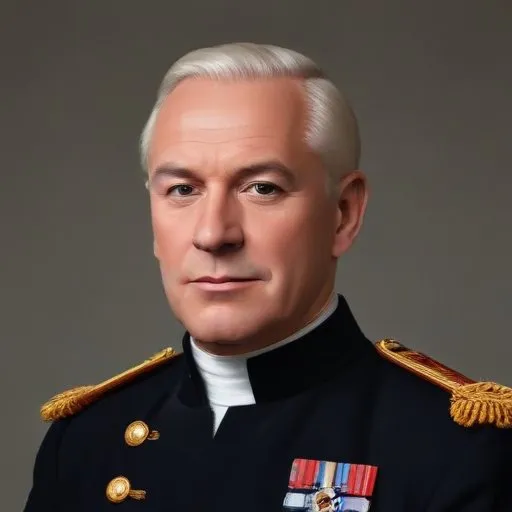
A British politician who served as Secretary of State for the Colonies, overseeing the decolonization of Africa and Asia in the mid-20th century, and playing a key role in shaping the modern Commonwealth.
Alan Lennox-Boyd, 1st Viscount Boyd of Merton, is renowned for his remarkable contributions to British politics, particularly during the late 1940s to the mid-1950s. As the Secretary of State for the Colonies, he played a crucial role in shaping the country's colonial policies, overseeing the early stages of decolonization, and granting independence to several nations, including Cyprus, Ghana, Malaya, and Sudan.
Born on November 18, 1904, to Alan Walter Lennox-Boyd and Florence Annie Begbie, Lennox-Boyd was educated at Sherborne School in Dorset and later graduated from Christ Church, Oxford, with a BA degree, which was later elevated to an MA.
During World War II, Lennox-Boyd served as a lieutenant in the Royal Naval Volunteer Reserve with Coastal Forces. In 1931, at the age of 26, he was elected as the Member of Parliament (MP) for Mid Bedfordshire. He was admitted to the Inner Temple as a barrister in 1941.
In 1952, Lennox-Boyd became the Minister for Transport and Civil Aviation in Winston Churchill's peacetime government. During his tenure, he made a memorable statement, citing that road accidents were a result of taking small risks a large number of times, rather than taking large risks.
In 1954, Lennox-Boyd assumed the role of Secretary of State for the Colonies, where he played a pivotal role in granting independence to several nations. He oversaw the early stages of decolonization, and his efforts led to the independence of Cyprus, Ghana, Malaya, and Sudan.
During his tenure as Secretary of State, Lennox-Boyd faced criticism for his handling of the Mau Mau Rebellion in Kenya. He was censured for the Hola massacre, but remained in office after being persuaded by Harold Macmillan.
Lennox-Boyd's contributions to British politics have had a lasting impact on the country's colonial policies. His efforts towards decolonization paved the way for the independence of several nations, shaping the course of history. Despite facing controversies, his commitment to the country's interests remained unwavering.
In recognition of his services, Lennox-Boyd was appointed a Companion of Honour (CH) in 1955. He was also conferred the title of 1st Viscount Boyd of Merton.
Lennox-Boyd married Lady Patricia Guinness in 1938, and they had three daughters together. He passed away on March 8, 1983, leaving behind a legacy of dedicated public service and a lasting impact on British politics.
In conclusion, Alan Lennox-Boyd, 1st Viscount Boyd of Merton, was a pivotal figure in British politics, who played a crucial role in shaping the country's colonial policies and granting independence to several nations. His contributions to the country's history will always be remembered and cherished.
Born in 1871
Prolific writer of historical novels and adventure stories, also a talented landscape painter.
Born in 1883
Led the Labour Party to a landslide victory in 1945, implementing significant social and economic reforms, including the creation of the National Health Service. He played a crucial role in shaping post-war Britain.
Born in 1897
A British politician who served as Prime Minister from 1955 to 1957, known for his role in the Suez Crisis and his diplomatic efforts during the Cold War.
Born in 1894
A British politician who served as Prime Minister from 1957 to 1963, known for leading the country through a period of economic prosperity and decolonization.
Born in 1903
A British aristocrat who served as Prime Minister from 1963 to 1964, known for his brief tenure and aristocratic background.
Born in 1885
Won the 1952 Olympic Games marathon in Helsinki, Finland, and held the world record in the marathon from 1952 to 1953.
Born in 1912
A British politician who served as Prime Minister from 1976 to 1979, known for his efforts to stabilize the economy and navigate the country through a period of industrial unrest.
Born in 1925
The first female Prime Minister of the United Kingdom, serving from 1979 to 1990, known for her conservative policies and leadership during the Falklands War.
