


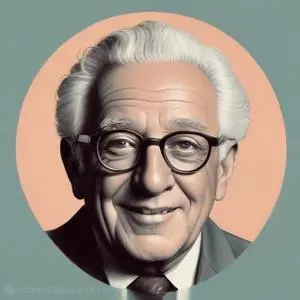
Developed Rational Emotive Behavior Therapy, a form of psychotherapy that helps individuals identify and change negative thought patterns. Known for his straight-talking, no-nonsense approach to mental health.
Despite these challenges, Ellis excelled in his education, earning an MA and PhD in clinical psychology from Columbia University. He was certified by the American Board of Professional Psychology (ABPP) and went on to establish the Albert Ellis Institute in New York City, serving as its president.
Ellis's philosophy is rooted in a humanistic and empirically-based approach, emphasizing the importance of self-awareness, self-acceptance, and self-responsibility. He argued that individuals have the capacity to change their beliefs, emotions, and behaviors through cognitive-behavioral techniques and self-reflection.
Some of Ellis's notable works include:
In 1982, a survey of American and Canadian psychologists ranked Ellis as the second most influential psychotherapist in history, after Carl Rogers. Sigmund Freud was ranked third in the same survey.
However, Ellis's legacy extends far beyond controversy. He remains a pioneering figure in the history of psychotherapy, leaving behind a rich body of work that continues to inspire and inform practitioners today.
As Psychology Today noted, "No individual—not even Freud himself—has had a greater impact on modern psychotherapy."
Ellis passed away on July 24, 2007, leaving behind a rich legacy that continues to inspire and empower individuals around the world.
Born in 1921
Developed cognitive-behavioral therapy, a widely used psychotherapeutic approach that helps individuals identify and change negative thought patterns and behaviors.
Born in 1902
Developed person-centered therapy, emphasizing empathy and genuineness to promote personal growth and self-actualization. Focused on creating a non-judgmental space for individuals to explore their thoughts and feelings.
Born in 1856
Pioneering psychoanalyst who developed theories on the subconscious mind, childhood experiences, and the structure of personality, revolutionizing our understanding of human behavior and psychology.
Born in 1904
Developed the theory of operant conditioning, which explores the relationship between behavior and environment, and invented the "Skinner box" to study learning and behavior.
Born in 1896
Developed groundbreaking theories on child cognitive development and learning, emphasizing active discovery and hands-on experience. His work has shaped modern education and parenting practices.
Born in 1902
Developed the theory of psychosocial development, which proposes that individuals go through eight stages of development from infancy to old age, each with its own unique challenges and opportunities. His work has had a significant impact on our understanding of human development and identity formation.
92 Years Old
A Nobel Prize-winning economist and psychologist who pioneered the field of behavioral economics, revealing how cognitive biases and heuristics influence human decision-making.
