


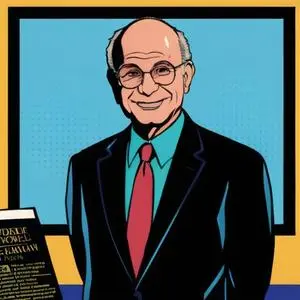
A Nobel Prize-winning economist and psychologist who pioneered the field of behavioral economics, revealing how cognitive biases and heuristics influence human decision-making.
Daniel Kahneman is a household name in the world of economics, known for his groundbreaking work on the psychology of judgment and decision-making. He's the pioneer who challenged the assumption of human rationality, introducing the concept of behavioral economics and earning the 2002 Nobel Memorial Prize in Economic Sciences.
Born in Tel Aviv, Mandatory Palestine (now Israel) on March 5, 1934, Kahneman spent his childhood years in Paris. His family's experiences during World War II, including his father's brief detention by the Nazis, deeply influenced his worldview and shaped his interest in human behavior.
Kahneman earned his bachelor's degree in psychology and mathematics from the Hebrew University of Jerusalem and went on to complete his Ph.D. in psychology from the University of California, Berkeley.
Kahneman's most significant contributions to the field of behavioral economics were made in collaboration with Amos Tversky. Together, they developed the concept of prospect theory, which explains how people make decisions under uncertainty. Their work challenged traditional economic theories and introduced the idea of cognitive biases and heuristics.
Kahneman's magnum opus, "Thinking, Fast and Slow" (2011), summarizes his research and provides a comprehensive understanding of human decision-making processes. The book became an instant bestseller, cementing Kahneman's status as a leading authority in the field.
Kahneman's contributions have been recognized with numerous awards and honors, including:
Kahneman's work has had a profound impact on modern society, influencing policy-making, business strategies, and individual decision-making. His ideas have been applied in fields such as:
Kahneman is married to cognitive psychologist Anne Treisman, who passed away in 2018. He is a professor emeritus of psychology and public affairs at Princeton University's Princeton School of Public and International Affairs.
Kahneman's legacy extends beyond his academic achievements. He has inspired a new generation of researchers and practitioners, and his work continues to shape our understanding of human behavior and decision-making.
"Nothing in life is as important as you think it is, while you are thinking about it."
This quote, from "Thinking, Fast and Slow," encapsulates Kahneman's philosophy on the importance of perspective and the limitations of human thinking.
Kahneman's work is built on the idea that human decision-making is prone to biases and heuristics. He believes that by understanding these limitations, we can develop strategies to overcome them and make better decisions.
His philosophical contributions have far-reaching implications, challenging traditional notions of human rationality and encouraging a more nuanced understanding of human behavior.
Daniel Kahneman's work has left an indelible mark on modern economics, psychology, and beyond. His ideas have inspired a new generation of researchers and practitioners, and his legacy will continue to shape our understanding of human behavior and decision-making for years to come.
As the "grandfather of behavioral economics," Kahneman's influence extends far beyond the realm of academia, shaping policy, business, and individual decision-making. His work will continue to inspire and inform, leaving a lasting impact on modern society.
89 Years Old
A pioneer in behavioral economics, he challenged traditional economic theories by showing how cognitive biases and heuristics influence human decision-making, revolutionizing our understanding of human behavior.
Born in 1912
A Nobel Prize-winning economist who championed free market capitalism and limited government intervention, known for his advocacy of laissez-faire economics and influential writings on monetary policy.
95 Years Old
A pioneer in applying economic theory to social issues, he's most known for his work on human capital, crime and punishment, and the economics of the family.
93 Years Old
A pioneering economist who challenged traditional theories by showing how communities can successfully manage shared resources, leading to a Nobel Prize in Economics in 2009.
Born in 1915
A renowned economist and academic who made significant contributions to the field of economics, particularly in the areas of macroeconomics and international trade. He was awarded the Nobel Prize in Economics in 1970.
Born in 1883
A pioneering economist who revolutionized modern economic theory with his groundbreaking ideas on government intervention and fiscal policy, shaping global economic policies.
