


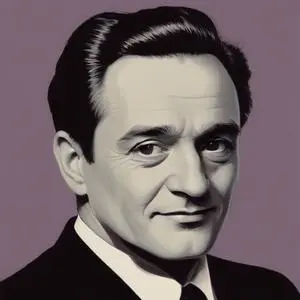
A renowned economist and academic who made significant contributions to the field of economics, particularly in the areas of macroeconomics and international trade. He was awarded the Nobel Prize in Economics in 1970.
Paul Samuelson is renowned for being the first American to win the Nobel Memorial Prize in Economic Sciences in 1970, a testament to his groundbreaking contributions to the field of economics. As a trailblazing economist, he revolutionized the discipline with his pioneering work in mathematical economics, macroeconomics, and international trade, leaving an indelible mark on the global economic landscape.
Born on May 15, 1915, in Gary, Indiana, Samuelson grew up in a family of upwardly mobile Jewish immigrants from Poland. His early life in Chicago, where he moved in 1923, laid the foundation for his future academic pursuits. He earned his Bachelor's degree from the University of Chicago in 1935 and went on to pursue his graduate studies at Harvard University, where he earned his Ph.D. in 1941.
Samuelson's magnum opus, Foundations of Economic Analysis, published in 1947, is a sweeping treatise that cemented his reputation as a master theoretical economist. This seminal work laid the mathematical foundations of economics, providing a rigorous framework for understanding economic phenomena. The book's influence extends beyond academia, shaping the discipline's trajectory for generations to come.
In 1948, Samuelson authored Economics: An Introductory Analysis, a textbook that would become a staple in economics education worldwide. This pioneering work introduced Keynesian economics to American audiences, making complex economic concepts accessible to a broader readership. With over 4 million copies sold, it remains the bestselling economics textbook of all time.
Samuelson's expertise extended beyond academia, as he served as an advisor to Presidents John F. Kennedy and Lyndon B. Johnson. He also worked as a consultant to the United States Treasury, the Bureau of the Budget, and the President's Council of Economic Advisers. His influence on economic policy and decision-making was profound, shaping the course of American economic history.
Samuelson's legacy is multifaceted, encompassing his contributions to economics, public service, and education. His work has inspired generations of economists, policymakers, and scholars, shaping the course of economic thought and policy. As a testament to his enduring impact, Samuelson's ideas continue to influence contemporary economic debates, ensuring his place as one of the most influential economists of the 20th century.
Through his life's work, Paul Samuelson has left an indelible mark on the world of economics, cementing his status as a towering figure in the annals of economic history.
Born in 1912
A Nobel Prize-winning economist who championed free market capitalism and limited government intervention, known for his advocacy of laissez-faire economics and influential writings on monetary policy.
Born in 1883
A pioneering economist who revolutionized modern economic theory with his groundbreaking ideas on government intervention and fiscal policy, shaping global economic policies.
92 Years Old
A renowned economist and philosopher who has made significant contributions to welfare economics, social choice theory, and development economics, and is known for his work on poverty, famine, and human development.
83 Years Old
A Nobel Prize-winning economist and academic who has made significant contributions to the field of economics, particularly in the areas of information economics and globalization.
Born in 1924
A Nobel Prize-winning economist who developed a growth model that showed technological progress is the primary driver of economic growth, and is known for his work on the theory of economic growth.
71 Years Old
A renowned economist and academic who served as the Chief Economist of the World Bank and Secretary of the Treasury, known for his influential economic policies and theories.
Born in 1926
Former Chairman of the Federal Reserve, guiding the US economy through periods of growth and crisis, and known for his influence on monetary policy.
72 Years Old
The Chairman of the Federal Reserve during the 2008 financial crisis, credited with implementing unconventional monetary policies to stabilize the economy. Known for his calm and decisive leadership during tumultuous times.
