


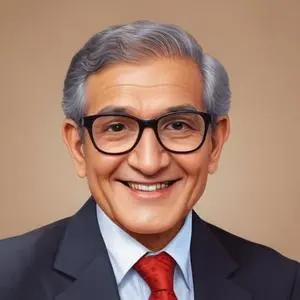
A renowned economist and philosopher who has made significant contributions to welfare economics, social choice theory, and development economics, and is known for his work on poverty, famine, and human development.
Amartya Sen is renowned for his groundbreaking contributions to welfare economics, social choice theory, and economic and social justice. The Nobel Memorial Prize in Economic Sciences in 1998 was a testament to his pioneering work, which has had a profound impact on our understanding of human wellbeing and development.
Born on November 3, 1933, in Santiniketan, Bengal, British India, Sen was named by the polymath and writer Rabindranath Tagore, the first Asian to win a Nobel Prize. His family, with roots in Wari and Manikganj, Dhaka, Bangladesh, valued education and public service. Sen's father, Ashutosh Sen, was a professor of chemistry, while his mother, Amita Sen, was the daughter of Kshiti Mohan Sen, an eminent Sanskritist and scholar of ancient and medieval India.
Sen has taught and worked in the United Kingdom and the United States since 1972, holding prestigious positions at the London School of Economics, Oxford University, and Harvard University, where he is currently the Thomas W. Lamont University Professor. His work has focused on:
Sen's work has had a significant impact on shaping global development policies, influencing organizations such as the United Nations, the World Bank, and the International Labour Organization. His ideas have also informed social and economic initiatives in countries like India, Bangladesh, and the United Kingdom.
Sen's contributions have been recognized with numerous awards, including:
Sen's work is characterized by a deep commitment to social justice, human rights, and individual freedoms. He has argued that economic development should be seen as a means to expand human capabilities and freedoms, rather than an end in itself. His philosophy is rooted in a nuanced understanding of human wellbeing, which goes beyond mere economic metrics.
Sen's life has been marked by significant personal milestones, including:
Sen's work has had a significant financial impact, influencing policy decisions and investment strategies in various sectors. While his personal net worth is not publicly disclosed, it is clear that his contributions have generated substantial benefits for individuals and societies worldwide.
Amartya Sen's legacy extends beyond his academic contributions, shaping the way we think about development, poverty, and social justice. As a visionary economist and philosopher, he has left an indelible mark on our understanding of human wellbeing and the quest for a more just and equitable society.
83 Years Old
A Nobel Prize-winning economist and academic who has made significant contributions to the field of economics, particularly in the areas of information economics and globalization.
73 Years Old
A Nobel Prize-winning economist and academic who has made significant contributions to the field of international trade and economic geography, and is also a prominent columnist and author.
Born in 1921
A Nobel Prize-winning economist who pioneered the theory of social choice and welfare economics, known for his work on the impossibility theorem, which challenges the idea of a perfectly fair voting system.
Born in 1921
Developed the concept of "justice as fairness" and argued that a just society should be based on principles that would be agreed upon by rational individuals behind a "veil of ignorance".
Born in 1924
A Nobel Prize-winning economist who developed a growth model that showed technological progress is the primary driver of economic growth, and is known for his work on the theory of economic growth.
Born in 1920
Developed econometric models that accurately predicted economic trends and fluctuations, earning him the Nobel Prize in Economics in 1980.
Born in 1918
A Nobel laureate who developed the Tobin tax, a levy on international currency transactions to reduce speculation and stabilize economies. His work has shaped modern economic policy and global finance.
