


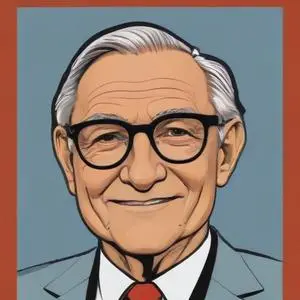
Developed econometric models that accurately predicted economic trends and fluctuations, earning him the Nobel Prize in Economics in 1980.
Lawrence Klein, a renowned American economist, is lauded for his trailblazing work in creating computer models to forecast economic trends, earning him the Nobel Memorial Prize in Economic Sciences in 1980. His groundbreaking contributions to the field of econometrics have had a profound impact on the analysis of economic fluctuations and economic policies, shaping the discipline for generations to come.
Born on September 14, 1920, in Omaha, Nebraska, Klein was the son of Blanche (née Monheit) and Leo Byron Klein. He graduated from Los Angeles City College, where he developed a strong foundation in calculus. Klein then pursued his undergraduate degree in Economics at the University of California, Berkeley, where he began to explore computer modeling. He earned his BA in Economics in 1942 and later went on to receive his PhD in Economics from the Massachusetts Institute of Technology (MIT) in 1944, where he was Paul Samuelson's first doctoral student.
Klein's research focus shifted to the Cowles Commission for Research in Economics, then based at the University of Chicago, where he constructed a model of the United States economy to predict business fluctuations and study the effects of government economic policies. During this period, Klein correctly forecasted an economic upturn following World War II, contra to prevailing expectations, and later predicted a mild recession at the end of the Korean War. These achievements solidified his position as a leading authority in econometrics.
Klein's unparalleled contributions to the field of econometrics were recognized with the Nobel Memorial Prize in Economic Sciences in 1980. This prestigious award acknowledged his pioneering work in creating econometric models and their application to the analysis of economic fluctuations and economic policies. Additionally, Klein received numerous honors and awards, including the John Bates Clark Medal (1960) and the National Medal of Science (1984).
Klein's work has had a profound impact on modern society, as his econometric models have become an indispensable tool for economists and policymakers worldwide. His contributions have enabled the development of more accurate economic forecasts, informing decisions that shape global economic policy. Harvard University professor Martin Feldstein noted that Klein's models have become the cornerstone of central banks, including the Federal Reserve Bank, demonstrating the enduring influence of his work.
Klein's philosophical underpinnings were rooted in Keynesian economics, which he skillfully integrated into his econometric models. These models embodied the principles of Keynesian economics, providing a statistical framework for policymakers to navigate the complexities of economic fluctuations.
Klein's groundbreaking work has left an indelible mark on the field of econometrics, paving the way for future generations of economists. His contributions are often compared to those of his contemporaries, including Paul Samuelson and Milton Friedman. While each of these economists made significant contributions to the field, Klein's pioneering work in econometric modeling has earned him a distinct place in the annals of economic history.
Lawrence Klein's remarkable legacy serves as a testament to the power of innovative thinking and intellectual curiosity. His pioneering contributions to econometrics have reshaped the discipline, informing economic policy and decision-making for generations to come.
Born in 1915
A renowned economist and academic who made significant contributions to the field of economics, particularly in the areas of macroeconomics and international trade. He was awarded the Nobel Prize in Economics in 1970.
Born in 1912
A Nobel Prize-winning economist who championed free market capitalism and limited government intervention, known for his advocacy of laissez-faire economics and influential writings on monetary policy.
Born in 1926
A prominent figure in the Austrian School of economics, known for his libertarian and anarchist views, and his work on the history of economic thought.
Born in 1883
A pioneering economist who revolutionized modern economic theory with his groundbreaking ideas on government intervention and fiscal policy, shaping global economic policies.
83 Years Old
A Nobel Prize-winning economist and academic who has made significant contributions to the field of economics, particularly in the areas of information economics and globalization.
92 Years Old
A renowned economist and philosopher who has made significant contributions to welfare economics, social choice theory, and development economics, and is known for his work on poverty, famine, and human development.
95 Years Old
A pioneer in applying economic theory to social issues, he's most known for his work on human capital, crime and punishment, and the economics of the family.
87 Years Old
A Nobel Prize-winning economist and academic who developed the Efficient Market Hypothesis, which revolutionized our understanding of stock markets and investments.
