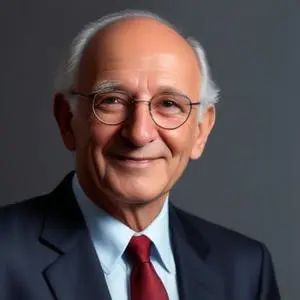
Gary Becker: The Nobel Laureate Who Revolutionized Economics
A Maverick Economist and Sociologist
Gary Becker, a renowned American economist, and sociologist, is best known for his pioneering work in applying economic theory to social phenomena. He was awarded the 1992 Nobel Memorial Prize in Economic Sciences for his groundbreaking research on human behavior, which challenged conventional wisdom and transformed the field of economics.
Early Life and Education
Born on December 2, 1930, in Pottsville, Pennsylvania, to a Jewish family, Becker grew up with a strong foundation in education. He received his BA from Princeton University in 1951, where he completed a senior thesis titled "The Theory of Multi-Country Trade." He then earned his PhD from the University of Chicago in 1955, with a thesis entitled "The Economics of Discrimination." At Chicago, Becker was heavily influenced by
Milton Friedman, whom he credited with renewing his interest in economics.
Career Highlights and Major Works
Becker's most notable contribution was his extension of economic theory to non-market behavior, such as racial discrimination, crime, family organization, and rational addiction. His work challenged traditional assumptions and paved the way for a new generation of economists. Some of his most influential works include:
- "The Economics of Discrimination" (1957)
- "Human Capital: A Theoretical and Empirical Analysis, with Special Reference to Education" (1964)
- "A Theory of the Allocation of Time" (1965)
- "Economic Theory" (1971)
Philosophical Contributions and Beliefs
Becker's work was characterized by a strong emphasis on the concept of "human capital," which posits that individuals make rational decisions about investments in their education, health, and other aspects of their lives. He believed that many seemingly irrational behaviors can be explained by applying economic principles to human decision-making. This approach led to a deeper understanding of social issues and challenged traditional views on topics like addiction and crime.
Influence on Modern Society
Becker's ideas have had a profound impact on modern society, influencing policy decisions and shaping the way we think about social issues. His work has been applied in various fields, including education, healthcare, and law enforcement. He has also inspired a new generation of economists and social scientists to explore the intersection of economics and sociology.
Awards and Honors
Throughout his career, Becker received numerous awards and honors, including:
- 1992 Nobel Memorial Prize in Economic Sciences
- 2007 United States Presidential Medal of Freedom
- 2011 survey of economics professors named him their favorite living economist over 60
Personal Milestones and Key Life Events
Becker was a professor of economics and sociology at the University of Chicago, where he spent most of his academic career. He was married to Guity Nashat Becker and had two children.
Legacy and Impact
Gary Becker's work has left an indelible mark on the field of economics and beyond. His pioneering approach has inspired a new wave of researchers and policymakers to explore the intersection of economics and sociology. As Milton Friedman noted, Becker was "the greatest social scientist who has lived and worked in the second part of the twentieth century."
FAQ
What is Gary Beckers most famous theory?
Gary Beckers most famous theory is the concept of human capital, which posits that individuals invest in education and training to increase their earning potential. This theory revolutionized the field of economics and had a profound impact on our understanding of human behavior.
What awards did Gary Becker win?
Gary Becker won numerous awards for his scholarship, including the Nobel Memorial Prize in Economic Sciences in 1992. He was also awarded the Presidential Medal of Freedom in 2007, the highest civilian honor in the United States.
What is Gary Beckers approach to economics?
Gary Beckers approach to economics is characterized by its emphasis on individual behavior and decision-making. He is known for his use of economic theory to analyze social phenomena, such as crime, family, and education, and for his ability to provide novel insights into human behavior.
What is Gary Beckers legacy in economics?
Gary Beckers legacy in economics is immense, with his work shaping our understanding of human behavior and decision-making. His theories have influenced generations of economists, and his work continues to be celebrated for its originality, depth, and impact.
What was Gary Beckers impact on public policy?
Gary Beckers impact on public policy was significant, with his theories influencing policy debates on issues such as education, crime, and welfare. His work helped shape the development of policy initiatives, such as charter schools and voucher programs, and his ideas continue to inform public policy discussions today.