


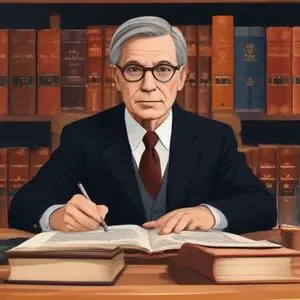
Developed the concept of "self-fulfilling prophecy" and coined terms like "role model" and "unintended consequences," greatly influencing sociology and social psychology.
Robert K. Merton, an American sociologist, is renowned for developing crucial concepts in sociology, criminology, and sociological theory. He is best known for coining the terms "role model" and "self-fulfilling prophecy," which have become integral to understanding human behavior and social structures.
Merton was born Meyer Robert Schkolnick on July 4, 1910, in Philadelphia. He later changed his name to Robert King Merton. He earned his Bachelor's degree from Temple University in 1931 and went on to pursue his Master's and Ph.D. from Harvard University, which he completed in 1936.
Merton's work revolves around three primary areas: sociology of science, sociology of crime and deviance, and sociological theory. He focused on understanding the intricacies of social structures, highlighting the importance of unintended consequences, reference groups, and role strain.
Merton's concept of self-fulfilling prophecy is a fundamental element in modern sociological, political, and economic theory. It describes how a belief or expectation can influence the outcome of a situation or an individual's behavior. He defined it as "in the beginning, a false definition of the situation evoking a new behavior, which makes the originally false conception come true."
Merton's concept of the role model emerged from his study on the socialization of medical students at Columbia University. He introduced the term as an extension of his theory of the reference group, which refers to the group to which individuals compare themselves, even if they don't necessarily belong to it. Social roles were central to Merton's theory of social groups, emphasizing that individuals assume multiple roles and statuses, each with its set of expected behaviors.
Merton received numerous accolades for his contributions to the field of sociology. In 1994, he was awarded the National Medal of Science, the highest scientific honor in the United States. He also served as the 47th president of the American Sociological Association.
Robert K. Merton's work has had a profound impact on modern sociology, influencing scholars and researchers across the globe. His concepts, such as the self-fulfilling prophecy and role model, continue to shape our understanding of human behavior and social structures. As a founding father of modern sociology, Merton's legacy is a testament to his groundbreaking contributions to the field.
Robert K. Merton's remarkable career and contributions have left an indelible mark on the field of sociology. His concepts and theories continue to inspire new generations of scholars, solidifying his place as one of the most influential sociologists of the 20th century.
Born in 1858
A founder of modern sociology, known for establishing the field and exploring the relationships between individuals and society, particularly in his work "Suicide".
Born in 1864
Developed the concept of "social action" and is known for his theories on bureaucracy, capitalism, and the role of religion in shaping society.
Born in 1818
A 19th-century philosopher who developed the theory of communism, arguing that capitalism would eventually be replaced by a socialist society. He's known for his critique of capitalism and the concept of class struggle.
Born in 1916
A pioneering sociologist who coined the term "power elite" and wrote influential books on social structure, criticizing the concentration of power and wealth in modern societies.
Born in 1802
Pioneering sociologist and writer who helped establish sociology as a distinct field, and is known for her influential writings on social theory, politics, and economics.
Born in 1820
A pioneering thinker who coined the phrase "survival of the fittest" and applied evolutionary principles to social sciences, shaping modern sociology and philosophy.
Born in 1902
Developed the social action theory, which explores how individuals interact with their social environments, and is known for his work on the sociology of medicine and the professions.
Born in 1863
Developed the theory of symbolic interactionism, which explores how individuals interact with and give meaning to the world around them through symbols and language.
