


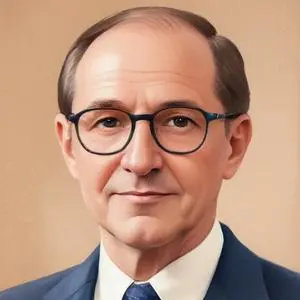
Developed the social action theory, which explores how individuals interact with their social environments, and is known for his work on the sociology of medicine and the professions.
Talcott Parsons, a towering figure in the realm of sociology, is renowned for his groundbreaking social action theory and structural functionalism. As one of the most influential sociologists of the 20th century, Parsons' work continues to shape the discipline, with his ideas permeating various aspects of modern society.
Born on December 13, 1902, in Colorado Springs, Colorado, Parsons grew up in a family of modest means. He pursued his undergraduate degree at Amherst College, followed by graduate studies in economics at the London School of Economics and Heidelberg University. In 1927, he earned his Ph.D. in economics from Heidelberg University, laying the foundation for his future contributions to sociology.
Parsons' academic career spanned over four decades, with his most notable association being with Harvard University. He joined Harvard's faculty in 1927 and played a pivotal role in establishing the university's sociology department in 1930. Some of his most significant works include:
Parsons' work was deeply influenced by the ideas of Max Weber, Émile Durkheim, and Vilfredo Pareto. He believed that social actions are shaped by cultural values and social structures, rather than internal psychological processes. This voluntaristic approach emphasized the role of individual agency within the constraints of societal norms and institutions.
Parsons' theories have had a profound impact on various aspects of modern society, including:
Throughout his life, Parsons was dedicated to his work and family. He was married to Helen Walker Parsons, and the couple had three children together. In 1975, Parsons published an article clarifying his theory, marking a significant milestone in his career.
Parsons' theories have been subject to criticism, with some accusing him of being socially conservative. In the 1970s, a new generation of sociologists criticized his work as overly complex and rigid. However, in recent years, there has been a resurgence of interest in his ideas, highlighting the enduring relevance of his contributions.
Talcott Parsons' legacy extends far beyond his own work. He has inspired generations of sociologists, and his ideas continue to shape the discipline. As a testament to his influence, Parsons was elected president of the American Sociological Association in 1949. His work remains a cornerstone of modern sociology, ensuring his place among the giants of the field.
"The most general and abstract concept of structure is the concept of a system of actions."
"The human individual is not a closed system; he is an open system, and his behavior is influenced by the social environment."
Parsons received numerous awards and honors for his contributions to sociology, including the American Sociological Association's Distinguished Scholarship Award.
1902: Born on December 13th in Colorado Springs, Colorado 1927: Earns Ph.D. in economics from Heidelberg University 1930: Joins Harvard University's faculty 1937: Publishes The Structure of Social Action 1949: Elected president of the American Sociological Association 1951: Publishes The Social System 1975: Publishes article clarifying his theory 1979: Passes away on May 8th
Parsons was an avid reader and had a vast personal library, which he later donated to the Harvard University Library.
Despite his passing in 1979, Parsons' work continues to be widely cited and studied, solidifying his position as one of the most influential sociologists of the 20th century.
Born in 1858
A founder of modern sociology, known for establishing the field and exploring the relationships between individuals and society, particularly in his work "Suicide".
Born in 1864
Developed the concept of "social action" and is known for his theories on bureaucracy, capitalism, and the role of religion in shaping society.
Born in 1820
A pioneering thinker who coined the phrase "survival of the fittest" and applied evolutionary principles to social sciences, shaping modern sociology and philosophy.
Born in 1910
Developed the concept of "self-fulfilling prophecy" and coined terms like "role model" and "unintended consequences," greatly influencing sociology and social psychology.
Born in 1916
A pioneering sociologist who coined the term "power elite" and wrote influential books on social structure, criticizing the concentration of power and wealth in modern societies.
Born in 1902
Developed the Lasswell's model of communication, which breaks down the communication process into five key elements: who, says what, in which channel, to whom, and with what effect. This model remains a fundamental concept in communication studies.
Born in 1818
A 19th-century philosopher who developed the theory of communism, arguing that capitalism would eventually be replaced by a socialist society. He's known for his critique of capitalism and the concept of class struggle.
Born in 1863
Developed the theory of symbolic interactionism, which explores how individuals interact with and give meaning to the world around them through symbols and language.
