


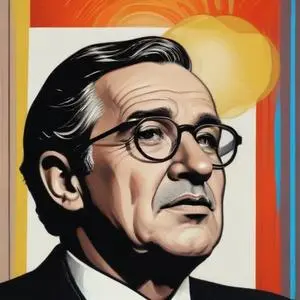
Developed the Lasswell's model of communication, which breaks down the communication process into five key elements: who, says what, in which channel, to whom, and with what effect. This model remains a fundamental concept in communication studies.
Harold Lasswell, a trailblazing American political scientist and communications theorist, left an indelible mark on the social sciences in the 20th century. With his groundbreaking work on the importance of personality, social structure, and culture in shaping political phenomena, Lasswell revolutionized the way we understand the intricate dynamics of human communication and its impact on society.
Born on February 13, 1902, in Donnellson, Illinois, Lasswell was raised by a clergyman and a school teacher. During his high school years, he served as editor of the school newspaper and delivered a memorable valedictory speech at graduation. His early influences, including his uncle, a physician who introduced him to Sigmund Freud's works, and an English teacher who exposed him to Karl Marx and Havelock Ellis, instilled in him a passion for academics.
Lasswell's academic journey began at the University of Chicago, where he earned his bachelor's degree in philosophy and economics. He later pursued his Ph.D. from the same institution. Throughout his career, Lasswell defied disciplinary boundaries, working in the fields of communication, political science, psychology, and sociology. His research focused on the role of personality, social structure, and culture in shaping political phenomena, challenging traditional notions of human communication.
Lasswell's contributions to the field of political science and communication are numerous. He served as a professor of law at Yale University and held prestigious positions as president of the American Political Science Association, American Society of International Law, and World Academy of Art and Science. His seminal work, Psychopathology and Politics, explored the psychological factors influencing political behavior.
Lasswell's work was deeply rooted in his belief that human behavior is shaped by a complex interplay of psychological, social, and cultural factors. He argued that understanding these dynamics is crucial for effective communication and policy-making. His ideas continue to influence modern communication theories, emphasizing the importance of empathy, cultural sensitivity, and critical thinking in shaping public discourse.
Lasswell's legacy extends beyond academia, with his work informing policy-making, international relations, and social justice movements. His ideas have inspired generations of scholars, policymakers, and social activists, shaping the way we approach communication, conflict resolution, and social change.
Lasswell's contributions to the social sciences have been widely recognized. He was honored with numerous awards and accolades, including the American Political Science Association's highest honor, the Woodrow Wilson Award.
In conclusion, Harold Lasswell's groundbreaking work has reshaped our understanding of human communication and its impact on society. His legacy continues to inspire scholars, policymakers, and social activists, cementing his place as one of the most influential thinkers of the 20th century.
As Gabriel Almond, a biographer, once noted, "Few would question that he was the most original and productive political scientist of his time." Harold Lasswell's contributions to the social sciences will continue to reverberate, shaping the course of human communication and social progress for generations to come.
Born in 1904
A pioneer in international relations theory, known for his realist approach, which emphasizes the role of power and national interest in shaping global politics.
Born in 1899
A renowned philosopher and academic who interpreted ancient Greek philosophers, particularly Plato and Aristotle, to understand modern politics and society. His ideas have influenced contemporary political thought and American conservatism.
Born in 1916
A pioneer in artificial intelligence, decision-making, and problem-solving, he's renowned for his work on bounded rationality and the concept of satisficing.
Born in 1917
A pioneer in political science, developing systems theory to analyze politics and governments, and authoring influential works like "The Political System".
