


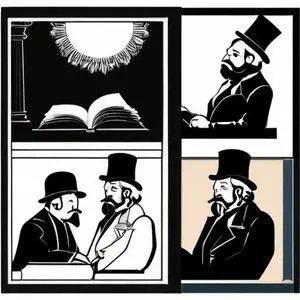
A 19th-century philosopher who developed the theory of communism, arguing that capitalism would eventually be replaced by a socialist society. He's known for his critique of capitalism and the concept of class struggle.
Karl Marx, a German philosopher, and economist is best known for his groundbreaking works, The Communist Manifesto and , which laid the foundation for modern socialism and communism. His critiques of capitalism and advocacy for a classless society have had a profound impact on economic and political thought, shaping the course of human history.
Marx was born on May 5, 1818, in Trier, Kingdom of Prussia, to a Jewish family. He studied philosophy at the University of Bonn and later at the University of Berlin, where he received a doctorate in philosophy in 1841. During his university days, Marx was heavily influenced by the philosophy of Georg Wilhelm Friedrich Hegel, which laid the groundwork for his future intellectual endeavors.
Marx's most notable works include:
Marx's ideas, collectively known as Marxism, have shaped modern intellectual, economic, and political history. His critique of capitalism and advocacy for a classless society have inspired socialist and communist movements worldwide. Marx's influence can be seen in:
Marx's closest friend and collaborator was Friedrich Engels, with whom he shared a lifelong bond. During his exile in Paris in 1844, Marx met Engels and began their partnership, which would last for over 40 years. Marx's wife, Jenny Westphalen, was a loyal companion and supported his work throughout his life.
Marx's ideas have been both praised and criticized. His critiques of capitalism have been seen as revolutionary, but his advocacy for a socialist state has been accused of leading to authoritarianism. The implementation of Marxist principles in countries like the Soviet Union and China has been marred by human rights abuses and economic inefficiencies.
"From each according to his ability, to each according to his needs."
"The ruling ideas of each age have ever been the ideas of its ruling class."
Marx's ideas emerged during a time of rapid industrialization and social change in Europe. His critiques of capitalism were influenced by the works of Adam Smith, David Ricardo, and Charles Fourier, among others. Marx's historical materialism was a response to the prevailing ideologies of the time, including liberalism and conservatism.
Marx was a prolific writer, producing over 1,000 pages of manuscripts in his lifetime.
He was a correspondent for the New York Tribune, writing over 500 articles between 1852 and 1862.
Marx's grave in Highgate Cemetery, London, is a popular tourist destination.
Karl Marx's contributions to modern social and economic thought are undeniable. His critiques of capitalism and advocacy for a classless society continue to shape political discourse and inspire social change. As a philosopher, economist, and historian, Marx's legacy remains a testament to the power of ideas to shape human history.
Born in 1820
A 19th-century philosopher and economist who co-authored "The Communist Manifesto" with Karl Marx, shaping modern socialist and communist thought. He also wrote extensively on economics, history, and politics.
Born in 1870
Founder of the world's first socialist state, leading the Bolshevik Revolution and establishing the Soviet Union, known for his radical Marxist ideology and authoritarian rule.
Born in 1879
Founded the Red Army and played a crucial role in the Russian Revolution, shaping the course of modern communism. A key figure in 20th-century politics and ideology.
Born in 1878
The Soviet Union's ruthless leader who ruled with an iron fist, implementing policies that led to widespread famine and purges, while also playing a crucial role in defeating Nazi Germany in World War II.
Born in 1893
Leader of the Chinese Communist Party who implemented radical social and economic reforms, including the Great Leap Forward and the Cultural Revolution, shaping modern China's politics and economy.
Born in 1926
The Cuban revolutionary who led the country from 1959 to 2008, implementing socialist policies and defying US opposition, becoming an iconic figure in modern history.
Born in 1871
A pioneering Marxist theorist and activist who advocated for workers' rights and criticized capitalism, known for her radical ideas on revolution and democracy.
Born in 1856
A Russian philosopher and theorist who developed Marxist theory and was a key figure in the Russian Revolution, known for his writings on dialectical materialism.
