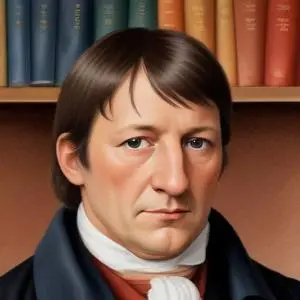
Georg Wilhelm Friedrich Hegel: The Pioneering Philosopher of German Idealism
A Legacy of Influential Thought
Georg Wilhelm Friedrich Hegel is renowned for his profound impact on 19th-century philosophy, casting a long shadow across various domains, including metaphysics, epistemology, ontology, political philosophy, philosophy of history, art, religion, and the history of philosophy. His magnum opus,
The Phenomenology of Spirit,
The Science of Logic, and his teleological account of history have cemented his status as a towering figure in the realm of philosophical thought.
Early Life and Formative Years
Born on August 27, 1770, in Stuttgart, Holy Roman Empire, Hegel's formative years were marked by the confluence of the Enlightenment and the Romantic movement in Germany. This unique historical context had a profound influence on his philosophical outlook, as he navigated the intellectual landscape of his time.
Education and Academic Pursuits
Hegel pursued his higher education at the Tübinger Stift (a seminary in Tübingen), where he befriended Friedrich Schelling and Friedrich Hölderlin. His academic pursuits took him to the University of Jena, where he earned his Ph.D. in 1801. Hegel's intellectual curiosity and passion for philosophy led him to assume various academic positions, including a stint as a professor at the University of Berlin.
Philosophical Contributions and Beliefs
Hegel's philosophical oeuvre is characterized by his relentless pursuit of understanding the human experience. He sought to reconcile the contradictions and dualisms inherent in modern philosophy, drawing inspiration from ancient Greek philosophy, particularly Aristotle. His dialectical-speculative method, grounded in the principle of immanence, aimed to assess claims according to their internal criteria.
- Hegel's emphasis on reason and freedom as historical achievements, rather than natural givens, underscores the significance of human experience in shaping our understanding of the world.
- His concept of absolute spirit, which encompasses the realms of logic, nature, and spirit, represents a seminal contribution to the philosophy of history.
- Hegel's teleological account of history, which posits that the universe is governed by reason, has far-reaching implications for our understanding of human progress and development.
Influence on Modern Society
Hegel's influence extends far beyond the realm of philosophy, permeating various aspects of modern society. His ideas have shaped:
- The development of Marxism, with Hegel's dialectics informing Marx's conception of class struggle.
- The evolution of existentialism, as seen in the works of Jean-Paul Sartre and Martin Heidegger.
- The modern understanding of history, with Hegel's teleological approach continuing to influence historiographical debates.
Major Works and Career Highlights
Hegel's published works include:
- The Phenomenology of Spirit (1807), a seminal work that explores the nature of consciousness and the human experience.
- The Science of Logic (1812-1816), a comprehensive treatment of logic and metaphysics.
- The Encyclopedia of the Philosophical Sciences (1817), a systematic exposition of his philosophical system.
Legacy and Historical Context
Hegel's philosophical legacy is inextricably linked to the tumultuous historical context in which he lived. The French Revolution and the Napoleonic Wars had a profound impact on his thought, as he grappled with the challenges of modernity and the rise of nationalism.
Personal Milestones and Key Life Events
Hegel's personal life was marked by significant milestones, including:
- His marriage to Marie von Tucher in 1811, with whom he had two sons.
- His appointment as a professor at the University of Berlin in 1818, a position he held until his death.
- His passing on November 14, 1831, leaving behind a rich philosophical legacy that continues to influence contemporary thought.
Quotes and Memorable Sayings
Hegel's philosophical insights are often encapsulated in his pithy quotes, including:
- "The true is the whole."
- "What is rational is actual, and what is actual is rational."
- "The owl of Minerva spreads its wings only with the falling of the dusk."
Hegel's profound impact on philosophy, his unwavering commitment to understanding the human experience, and his enduring legacy continue to inspire and challenge scholars across the globe. His philosophical contributions remain a testament to the power of human inquiry, shaping our understanding of the world and our place within it.
FAQ
Who was Georg Wilhelm Friedrich Hegel?
Georg Wilhelm Friedrich Hegel was a German philosopher who is considered one of the most important figures in German idealism. He is known for his comprehensive and systematic philosophy, which covers topics such as logic, metaphysics, and political philosophy.
What is Georg Wilhelm Friedrich Hegels most famous work?
Georg Wilhelm Friedrich Hegels most famous work is the Phenomenology of Spirit, which is a comprehensive treatment of his philosophical system. It is considered one of the most important philosophical works of the 19th century.
What is Georg Wilhelm Friedrich Hegels concept of the Absolute Spirit?
Georg Wilhelm Friedrich Hegels concept of the Absolute Spirit is a central idea in his philosophy, which refers to the ultimate reality that underlies all existence. It is the highest stage of development of the human spirit, in which all contradictions are reconciled and unity is achieved.
How did Georg Wilhelm Friedrich Hegel influence Marxism?
Georg Wilhelm Friedrich Hegels philosophy had a significant influence on Marxism, particularly in the development of dialectical materialism. Marx and Engels were heavily influenced by Hegels ideas on dialectics and the unity of opposites.
What was Georg Wilhelm Friedrich Hegels legacy in philosophy?
Georg Wilhelm Friedrich Hegels legacy in philosophy is marked by his comprehensive and systematic philosophy, which has had a profound influence on many areas of thought, including metaphysics, epistemology, ethics, and politics. He is considered one of the most important philosophers of the modern era.