


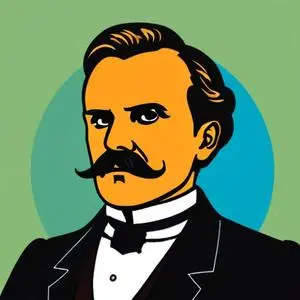
Friedrich Nietzsche, a 19th-century German philosopher, is renowned for his radical and provocative ideas that challenged the foundation of traditional morality, religion, and philosophy. He is best known for his concept of the "Will to Power," the idea that life's driving force is the struggle for power and self-overcoming, and his famous declaration that "God is Dead," which rejects the idea of a higher power and asserts that humanity must create its own values.
Born on October 15, 1844, in Röcken, Germany, Nietzsche's early life was marked by tragedy, with the death of his father when he was just five years old. He was educated at the University of Bonn, where he studied theology and classical philology. In 1869, at the age of 24, he became the youngest person to hold the Chair of Classical Philology at the University of Basel in Switzerland.
Nietzsche's philosophy is characterized by his rejection of traditional morality and the search for new values. He believed that traditional morality was based on a false premise, and that it stifled individual creativity and excellence. He argued that humanity must embrace life's difficulties and create its own values, rather than relying on external authorities.
Key concepts in Nietzsche's philosophy include:
Nietzsche's ideas have had a profound impact on modern society, influencing fields such as philosophy, literature, art, and psychology. His philosophy has been both praised and criticized, with some seeing him as a visionary and others as a nihilist.
Some notable influences of Nietzsche's ideas include:
Nietzsche's life was marked by illness and personal struggles. He suffered from migraines, dyspepsia, and eventually, a mental breakdown in 1889, which left him incapacitated for the rest of his life. Despite his struggles, he continued to write, producing some of his most influential works during this period.
Nietzsche's ideas have been the subject of controversy and debate, with some seeing him as a precursor to fascist and nationalist ideologies. His sister, Elisabeth Förster-Nietzsche, edited and published his works after his death, often distorting his ideas to fit her own nationalist agenda.
Nietzsche's writings are filled with memorable quotes and aphorisms, including:
Nietzsche's philosophy is a reflection of the intellectual and cultural currents of his time. His ideas were shaped by the Enlightenment, the Industrial Revolution, and the rise of nationalism in Europe.
Today, Nietzsche's philosophy remains a subject of study and debate, with his ideas continuing to influence contemporary thought and culture. Despite the controversies surrounding his ideas, his philosophy remains a powerful critique of traditional morality and a call to individual creativity and excellence.
Born in 1788
A pessimistic philosopher who wrote about the human condition, emphasizing the struggles and sufferings of life, and is famous for his concept of the "will to life".
Born in 1813
A revolutionary composer who transformed opera with his epic, mythological works, creating a new era of musical storytelling. His iconic operas, such as "Der Ring des Nibelungen," continue to captivate audiences worldwide.
Born in 1749
A German literary giant who penned iconic works like "Faust" and "The Sorrows of Young Werther", shaping the Romantic movement and influencing countless writers.
Born in 1724
Developed influential philosophical frameworks, such as the Critique of Pure Reason, that shaped modern Western thought on ethics, morality, and human understanding.
Born in 1770
A German philosopher and academic who developed a comprehensive and systematic philosophy that emphasized the unity of all things and the dialectical process of thesis, antithesis, and synthesis. His ideas have had a profound impact on modern thought, influencing fields such as philosophy, politics, and art.
Born in 1813
A Danish philosopher and author who is considered the father of existentialism, known for his philosophical and theological writings that emphasized individualism and subjective experience.
Born in 1889
A German philosopher and academic who explored the meaning of existence, time, and human existence, influencing 20th-century philosophy with his concept of "Being-in-the-world".
Born in 1905
Existentialist philosopher and playwright who argued that humans have complete freedom to choose their actions and create their own meaning in life, influencing modern thought on morality and individual responsibility.
