


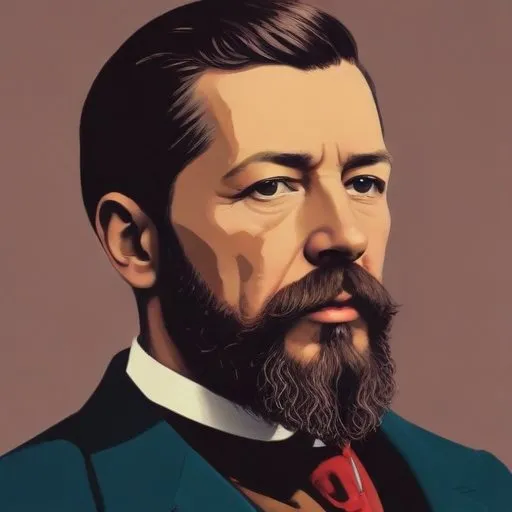
A 19th-century philosopher who critiqued religion and idealism, arguing that God is a human creation and that people should focus on this life rather than the afterlife. His ideas influenced many prominent thinkers, including Karl Marx and Friedrich Nietzsche.
Ludwig Feuerbach was a German philosopher and anthropologist, best known for his book The Essence of Christianity, which provided a critique of Christianity that strongly influenced generations of later thinkers, including Charles Darwin, Karl Marx, Sigmund Freud, and Friedrich Nietzsche.
Feuerbach was born on July 28, 1804, in Landshut, Bavaria, to a family of intellectuals. His father, Paul Johann Anselm Ritter von Feuerbach, was a distinguished jurist, and his brothers and sisters were all accomplished in various fields, including mathematics, archaeology, and philology.
Feuerbach matriculated in the University of Heidelberg in 1823, initially intending to pursue a career in the Lutheran church. However, through the influence of Karl Daub, he became interested in the philosophy of Hegel and transferred to the University of Berlin in 1824 to study under the master himself. After two years, the Hegelian influence began to wane, and Feuerbach became associated with the Young Hegelians, a group of philosophers who sought to challenge traditional Christian theology.
Feuerbach's most famous work, The Essence of Christianity, was published in 1841 and caused a stir in theological circles. In it, he argued that Christianity was not a divine revelation but a human invention, and that the attributes of God were merely projections of human nature. This critique of Christianity was a radical departure from traditional theology and had a profound impact on many young thinkers of the time.
Feuerbach's ideas influenced a wide range of thinkers, from Charles Darwin, who credited The Essence of Christianity with shaping his views on evolution, to Karl Marx, who saw Feuerbach as a precursor to his own materialist philosophy. Sigmund Freud, Friedrich Nietzsche, and Friedrich Engels were also among those who were influenced by Feuerbach's ideas.
Feuerbach was an advocate of atheism and anthropological materialism, and his philosophical writings offered a critical analysis of religion. He believed that human beings had a tendency to project their own qualities and desires onto God, and that this projection was the basis of religious belief.
Feuerbach's critique of Christianity was not without controversy. Many saw him as an enemy of religion, and his ideas were criticized by traditional theologians and philosophers. However, his work also inspired a new generation of thinkers to question the role of religion in society.
Ludwig Feuerbach's ideas continue to influence modern thought, from anthropology to philosophy. His critique of Christianity remains a powerful challenge to traditional theology, and his emphasis on the role of human nature in shaping religious belief continues to resonate with scholars and thinkers today.
Feuerbach's personal life was marked by a deep commitment to his ideas and a sense of isolation from the intellectual mainstream. Despite this, he maintained close relationships with his family and was particularly close to his brother, the mathematician Karl Wilhelm Feuerbach.
Feuerbach's ideas have had a subtle but significant impact on popular culture, from literature to music. His critique of Christianity has inspired many artists and writers to explore the role of religion in society, and his emphasis on the power of human nature has influenced the work of many thinkers and creators.
Born in 1818
A 19th-century philosopher who developed the theory of communism, arguing that capitalism would eventually be replaced by a socialist society. He's known for his critique of capitalism and the concept of class struggle.
Born in 1820
A 19th-century philosopher and economist who co-authored "The Communist Manifesto" with Karl Marx, shaping modern socialist and communist thought. He also wrote extensively on economics, history, and politics.
Born in 1788
A pessimistic philosopher who wrote about the human condition, emphasizing the struggles and sufferings of life, and is famous for his concept of the "will to life".
Born in 1724
Developed influential philosophical frameworks, such as the Critique of Pure Reason, that shaped modern Western thought on ethics, morality, and human understanding.
Born in 1905
Existentialist philosopher and playwright who argued that humans have complete freedom to choose their actions and create their own meaning in life, influencing modern thought on morality and individual responsibility.
Born in 1889
A German philosopher and academic who explored the meaning of existence, time, and human existence, influencing 20th-century philosophy with his concept of "Being-in-the-world".
Born in 1885
A German philosopher who explored the concept of utopia and the human desire for a better world, influencing Marxist thought and critical theory.
